
Anúncios
Between 1969 and 1972, twelve people walked on the Moon.
They got there using computers far less powerful than a modern calculator,
a rocket as tall as a 36-story building and a flight plan so daring that many engineers first dismissed it.
Anúncios
To understand how the Apollo landings actually worked,
it helps to look at the hardware and the key design decision behind it, each stage of a mission,
the highlights of all six landings and what the astronauts brought back.
The Hardware: Rocket, Command Ship and Lander
Every Apollo landing began with the Saturn V, a three-stage rocket about 111 meters (363 feet) tall.
Its first stage alone used five enormous F-1 engines producing about 7.5 million pounds of thrust,
burning through its propellant in roughly two and a half minutes.
On top sat the spacecraft, which came in three parts:
- The command module: a cone-shaped capsule where the three astronauts lived during the journey, and the only piece that came back to Earth.
- The service module: a cylinder attached behind the capsule, holding the main engine, oxygen, water and electrical power for the trip.
- The lunar module: a spindly two-stage lander built only for the Moon's airless, low-gravity environment. To save weight, parts of its aluminum skin were only about as thick as a few sheets of paper.
The Big Decision: Lunar Orbit Rendezvous
Early plans imagined landing one huge spacecraft directly on the Moon and flying it all the way back.
That would have required a rocket far larger than even the Saturn V.
A NASA engineer named John Houbolt championed a lighter alternative called lunar orbit rendezvous.
The main ship would stay in orbit around the Moon while a small, specialized lander carried two astronauts to the surface and back up.
Because the lander did not need a heat shield, a return engine for Earth or supplies for the whole trip, it could be much lighter.
The approach seemed risky, since it required two spacecraft to find and dock with each other far from home, but NASA adopted it in 1962.
It is a big reason Apollo succeeded within the decade.
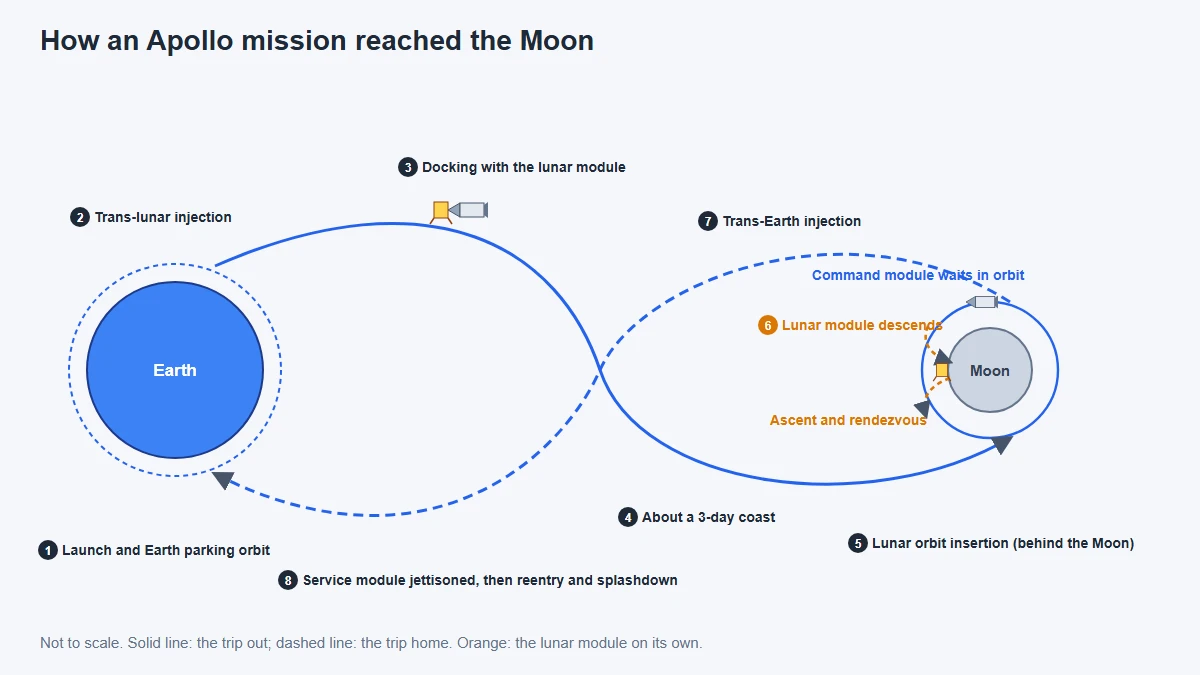
An Apollo Mission, Step by Step
A typical landing mission lasted between about 8 and 12 days and followed the same basic sequence:
- Launch: The Saturn V lifted off from Kennedy Space Center in Florida, dropping its first two stages within about ten minutes and reaching a parking orbit around Earth.
- Heading for the Moon: After the crew checked their systems, the third stage fired again, pushing the spacecraft to nearly 40,000 kilometers per hour (about 24,000 miles per hour).
- Docking with the lander: The command and service modules separated, turned around, docked with the lunar module and pulled it free of the spent rocket stage.
- The coast: The crew spent about three days drifting toward the Moon, making small course corrections along the way.
- Entering lunar orbit: The service module engine fired while the spacecraft was behind the Moon, out of radio contact with Earth, slowing it enough to be captured.
- Descent: Two astronauts crawled into the lunar module, undocked and fired its descent engine to land, while the third stayed in orbit.
- Surface work: The moonwalkers collected samples, took photographs and set up experiments.
- Liftoff and rendezvous: The upper half of the lander blasted off, using the lower half as a launch pad, and docked with the waiting command ship.
- Homecoming: The crew fired the main engine to leave lunar orbit, discarded the service module just before reaching Earth, and plunged into the atmosphere at close to 40,000 kilometers per hour. Parachutes lowered the capsule to a splashdown in the ocean.
Apollo 11: The First Landing
Apollo 11 launched on July 16, 1969, carrying Neil Armstrong, Buzz Aldrin and Michael Collins.
On July 20, Armstrong and Aldrin began their descent in the lunar module Eagle while Collins orbited alone in the command module Columbia.
The landing was tense.
The guidance computer flashed unfamiliar alarms as it became overloaded, and mission controllers had seconds to decide it was safe to continue.
Near the surface, Armstrong saw that the computer was steering them toward a crater strewn with boulders,
so he took partial manual control and flew past it, landing on the Sea of Tranquility with fuel running low.
Hours later, Armstrong became the first person to step onto the Moon, with Aldrin following soon after.
They spent about two and a half hours outside, collected roughly 21.5 kilograms (47.5 pounds) of rock and soil,
and set up a seismometer and a laser reflector. The crew splashed down in the Pacific Ocean on July 24.
The Missions That Followed
Apollo 12 and Pinpoint Landing
In November 1969,
Apollo 12 proved that NASA could land exactly where it wanted. Its crew touched down within walking distance of Surveyor 3,
a robotic lander that had arrived two and a half years earlier, and brought pieces of it home for study.
Apollo 13 and the Rescue
In April 1970, an oxygen tank in Apollo 13's service module exploded on the way to the Moon, crippling the spacecraft.
The landing was abandoned, and the three astronauts used the lunar module as a lifeboat, swinging around the Moon and returning safely.
The mission became a lasting lesson in teamwork under pressure.
Longer Stays and Moon Cars
Apollo 14 returned to the Moon in 1971. The final three missions, Apollo 15, 16 and 17,
carried an electric Lunar Roving Vehicle that let astronauts range several kilometers from their landers during stays of about three days.
Apollo 17, in December 1972, included geologist Harrison Schmitt, the only professional scientist among the moonwalkers.
Planned missions beyond Apollo 17 were canceled as budgets shrank.
What Apollo Taught Us About the Moon
Altogether, the six landings returned about 382 kilograms (842 pounds) of lunar material, and scientists around the world have studied it for decades.
Some of the key lessons:
- The Moon is roughly 4.5 billion years old, and its bright highlands formed from rock that crystallized out of an early global ocean of magma.
- The dark plains known as maria are ancient lava flows that filled huge impact basins.
- The Moon's chemistry is closely related to Earth's, supporting the idea that it formed from debris after a giant collision with the young Earth.
- Seismometers left behind recorded moonquakes, revealing clues about the Moon's interior.
Laser reflectors placed by Apollo 11, 14 and 15 let observatories bounce laser pulses off the Moon to measure its distance with extraordinary precision.
Those measurements showed that the Moon is slowly drifting away from Earth, by about 3.8 centimeters (1.5 inches) a year.
How We Know the Landings Happened
Occasional claims that the landings were staged do not hold up.
The lunar samples differ from Earth rocks in ways that were impossible to fake at the time, and researchers in many countries have examined them.
The Soviet Union, which had every reason to expose a hoax, tracked the missions and never disputed them.
Much later, a NASA orbiter photographed the landing sites from lunar orbit, showing the leftover descent stages,
scientific equipment and even the dark trails of astronaut footpaths and rover tracks.
A Giant Leap, Looking Back
The Apollo landings combined raw rocket power with an elegant flight plan, relentless testing and extraordinary courage.
In just over three years,
twelve astronauts explored six different sites and brought home a scientific treasure that is still being studied. On your next clear night,
look for the dark patch of the Sea of Tranquility on the Moon's face,
and you will be looking right at the place where it all began.
Sources and Further Reading
This article was reviewed by the LoudComet editorial team against the official sources below. Mission details and sky events change over time, so check the agencies' own pages for the latest information.
- Apollo 11 Mission Overview, NASA: Apollo 11's launch on July 16, 1969, the July 20 landing by Armstrong and Aldrin, the surface experiments and the Pacific splashdown.
- The Apollo Program, NASA: The choice of lunar orbit rendezvous in 1962, the three-part Apollo spacecraft and the Saturn V used for lunar flights.
- John C. Houbolt, NASA: John Houbolt's campaign for lunar orbit rendezvous, the plan NASA adopted in 1962.
- Lunar Rocks and Soils from Apollo Missions, NASA Johnson Space Center (Astromaterials Curation): The 382 kg (842 lb) of lunar samples brought back by six Apollo missions between 1969 and 1972.
- Apollo 11 Command Module Columbia, Smithsonian National Air and Space Museum: The three-part Apollo spacecraft and the command module as the only part of it that returned to Earth.