
Anúncios
Many experienced astronomers give the same advice to beginners: before you buy a telescope, pick up a pair of binoculars.
It can sound like a consolation prize, but it is not.
Binoculars show thousands of stars invisible to the naked eye, reveal craters on the Moon and bring star clusters and even galaxies within easy reach.
Anúncios
They are also quick, portable and simple enough to grab on any clear evening.
Here is what the numbers on binoculars mean, which sizes suit astronomy,
how to hold them steady and which targets to try first from either hemisphere.
Why Binoculars Make Sense First
Binoculars have advantages that even good telescopes lack.
You use both eyes, which is more comfortable and helps your brain pick out faint detail.
The image is upright and matches what you see with your eyes, so moving from a star pattern to a target is intuitive.
The wide field of view makes finding things far easier than through a telescope's narrow view.
There is no setup, no cooling time and no alignment. You step outside, look up and start observing.
And if you later buy a telescope, your binoculars remain useful as a scouting tool,
a finder and a companion for travel, as well as for birds and landscapes by day.
Decoding the Numbers
Every pair of binoculars carries two numbers, such as 7x50 or 10x50.
The first is the magnification: 7x makes objects appear seven times closer.
The second is the diameter of each front lens, called the objective, in millimeters.
Bigger objectives collect more light, which matters more for astronomy than magnification does.
Divide the objective size by the magnification and you get the exit pupil, the width of the beam of light that reaches your eye.
A 7x50 has an exit pupil of about 7 millimeters; a 10x50 has 5 millimeters.
A young, dark-adapted eye can open to around 7 millimeters, but maximum pupil size tends to shrink with age,
so older observers may not benefit fully from a very large exit pupil and often find a 10x50 a better match.
Two other specifications are worth reading.
The field of view, given in degrees or as a width in feet or meters at a set distance,
tells you how much sky you see at once.
Eye relief tells you how far from the eyepiece your eye can be while still seeing the full view, which matters if you wear glasses.
Common Sizes Compared
| Size | Exit pupil | Best suited to |
|---|---|---|
| 7x35 | 5 mm | Light, compact, good all-round and travel pair |
| 8x42 | About 5 mm | Versatile for astronomy and daytime use |
| 7x50 | About 7 mm | Very wide, bright views, steady to hand-hold |
| 10x50 | 5 mm | Popular astronomy choice, more detail but slightly harder to hold steady |
| 15x70 | About 4.7 mm | Deeper views of clusters and galaxies, needs a tripod |
For most people, a 7x50 or a 10x50 is the sweet spot.
Around 10x is roughly the upper limit for comfortable hand-holding; beyond that, every heartbeat shows up as a shaky view and a tripod becomes essential.
Features Worth Checking
- Prism type. Porro-prism binoculars have the classic offset shape and often give excellent value for astronomy. Roof-prism models have straight barrels and are more compact but generally cost more for similar optical quality.
- Coatings. Look for fully multi-coated optics, meaning every glass surface has anti-reflection coatings that improve brightness and contrast.
- A round exit pupil. Hold the binoculars at arm's length toward a bright wall and look at the small disc of light in each eyepiece. It should be evenly round; squared-off gray edges point to lower-grade prisms that waste light.
- A tripod socket. A threaded socket for a tripod adapter makes a huge difference with larger or higher-power binoculars.
- Weight. Heavy binoculars tire your arms fast. Try holding a pair above your head for a minute before you decide.
- Alignment. If you see a double image or feel eye strain, the two barrels may be out of alignment. Good binoculars merge into a single, relaxed view.
How to Hold Them Steady
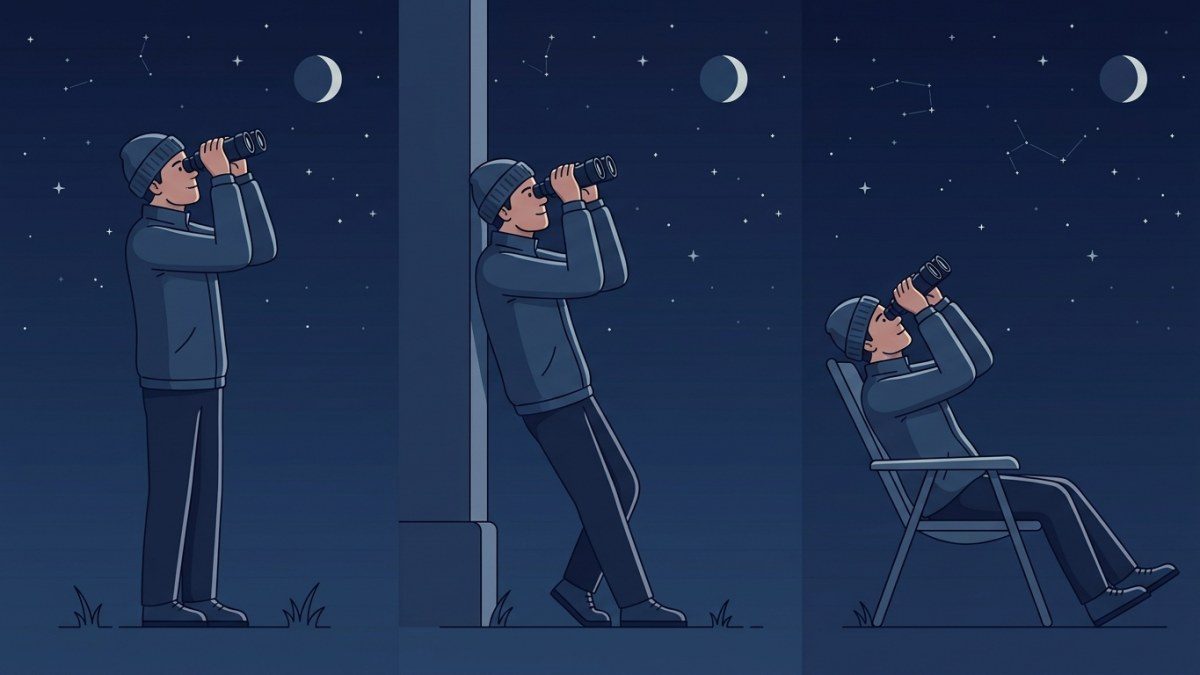
Shake is the biggest enemy of binocular astronomy.
Tuck your elbows against your chest, hold the binoculars near the front rather than the eyepiece end, and breathe slowly.
Leaning against a wall, a car or a tree helps a great deal.
The most comfortable method of all is a reclining lawn chair with armrests,
which supports your arms and lets you look high overhead without neck strain.
For larger binoculars, mount them on a photo tripod with an adapter, or on a monopod you can brace against your body.
Focusing Properly
First adjust the hinge so the two eyepieces match the distance between your eyes and you see one circular field.
Then close your right eye and turn the central focus wheel until a star looks like a sharp point in your left eye.
Finally, close your left eye and use the adjustable ring on the right eyepiece, called the diopter, to sharpen the view for your right eye.
Your binoculars are now tuned to your eyes.
What to Look At First
Start with the Moon, where binoculars reveal craters, mountain ranges and dark lava plains, especially along the line between light and shadow.
Then try these:
- Jupiter's moons. Up to four tiny points lined up beside the planet, shifting position from night to night.
- The Pleiades and Hyades. Two star clusters in Taurus, visible from both hemispheres and stunning at low power.
- The Orion Nebula. A misty glow in Orion's sword, a cloud of gas where new stars are forming.
- The Beehive Cluster. A swarm of stars in Cancer, easy on northern spring evenings and southern autumn evenings.
- The Andromeda Galaxy. An elongated glow best seen on northern autumn evenings, and low in the north from southern latitudes.
- The Double Cluster. Two rich clusters side by side in Perseus, a showpiece for northern observers.
- Southern treasures. Omega Centauri, a huge ball of stars; the Jewel Box beside the Southern Cross; the glowing Carina Nebula; and the Large and Small Magellanic Clouds, satellite galaxies of our own.
- The Milky Way. Sweep slowly through Sagittarius, Scorpius or Cygnus from a dark site and the view fills with star clouds.
A Word on Solar Safety
Binoculars concentrate sunlight just as a magnifying glass does.
Never point them at or near the Sun unless both front lenses are covered by certified solar filters made for binoculars,
and never let children use binoculars unsupervised when the Sun is up.
Looking at the Sun through unfiltered binoculars can cause instant and permanent eye damage.
When looking for a bright planet in twilight, wait until the Sun has fully set.
Frequently Asked Questions
Are zoom binoculars a good idea?
Generally not for astronomy.
Zoom designs tend to have narrower fields of view and softer images, and the two sides can drift out of alignment as you zoom.
A fixed magnification gives a brighter, sharper view.
Can I use the binoculars I already own?
Almost certainly.
Even a small 8x25 or 8x30 pair shows more stars than your eyes alone and gives lovely views of the Moon.
Larger objectives simply show fainter targets.
Are image-stabilized binoculars worth it?
They electronically cancel hand shake, which can reveal noticeably more detail, especially at higher powers.
They cost more, need batteries and are not essential, but they are a real improvement if shake bothers you.
The Takeaway
A 7x50 or 10x50 pair of binoculars, held steadily and focused carefully, opens up a sky far richer than most beginners expect.
Learn the major star patterns, sweep the Milky Way and follow Jupiter's moons from night to night.
Whatever you add later, your binoculars will stay one of your most-used instruments.
Sources and Further Reading
This article was reviewed by the LoudComet editorial team against the official sources below. Mission details and sky events change over time, so check the agencies' own pages for the latest information.
- Binoculars: A Great First Telescope, NASA Night Sky Network: The first number is magnification and the second the lens size in mm; 7x35 to 10x50 suit beginners; larger pairs are hard to hold steady.
- Skywatching Tips From NASA, NASA Science: Binoculars are a great first instrument, show clusters and Jupiter's four largest moons, and work best steadily mounted on a tripod.
- Solar Filters for Optics: Telescopes, Binoculars & Cameras, American Astronomical Society: Solar filters must be attached securely to the front of binoculars or telescopes before they are pointed at the Sun.
- The Solar System through your own telescope, Royal Museums Greenwich (Royal Observatory): Jupiter's four large moons can be seen with binoculars, and Venus shows phases like the Moon.