
Anúncios
Thousands of working satellites circle Earth, delivering weather forecasts, TV signals, internet connections and the navigation data behind the map on your phone.
None of them has an engine running to hold it up, and most will stay aloft for years.
So what keeps them from crashing down?
Anúncios
The surprising answer is that satellites are falling all the time.
They simply move sideways so fast that they keep missing the ground.
Once that idea clicks, it also explains why different satellites fly at different heights and what eventually brings them back to Earth.
Newton's Cannonball
More than 300 years ago, Isaac Newton described a thought experiment that still explains orbits beautifully.
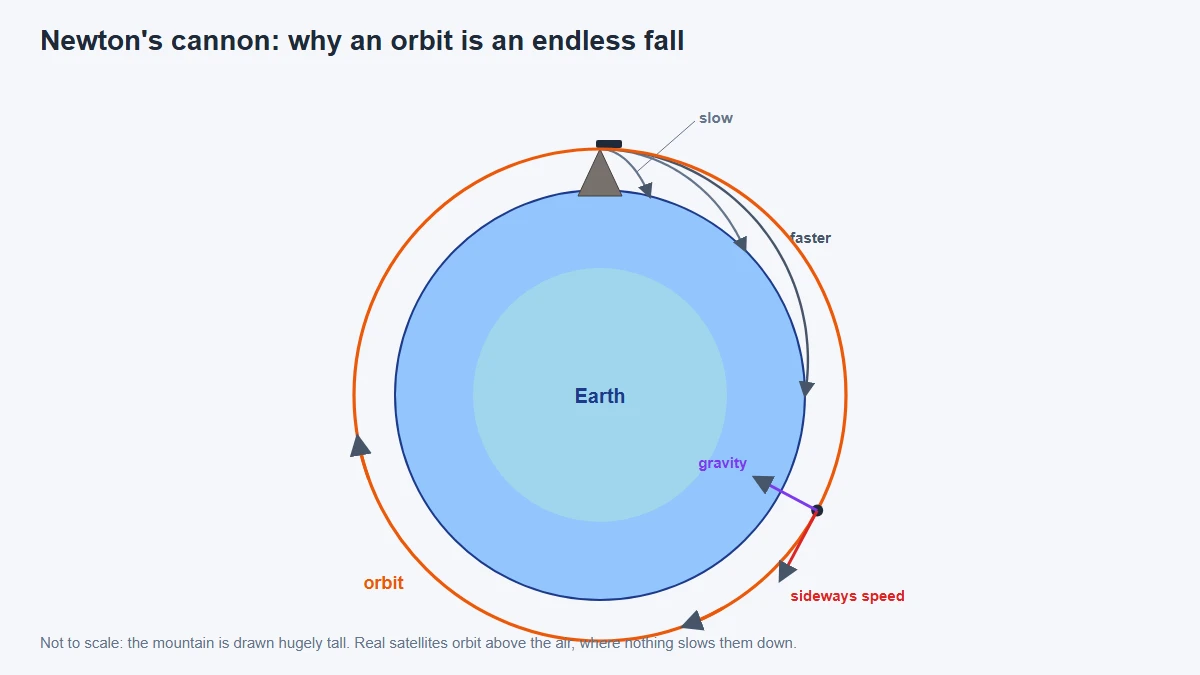
Imagine a cannon on top of an impossibly tall mountain, firing cannonballs horizontally.
A slow cannonball curves down and lands near the base of the mountain.
Fire the next one faster, and it lands farther away.
Keep increasing the speed, and eventually the cannonball travels so fast that as it falls, the curved Earth drops away beneath it just as quickly.
It never lands. It keeps falling around the planet, all the way back to the mountain.
That endless fall is an orbit.
Falling Around the Earth
Earth's surface curves downward about 5 meters for every 8 kilometers you travel across it.
Meanwhile, an object falling freely near Earth's surface drops about 5 meters in its first second.
So if something moves sideways at roughly 8 kilometers per second,
it falls about as far as the ground curves away, and it stays at the same height.
That is almost exactly the speed of a satellite in low orbit: about 7.8 kilometers per second,
or 28,000 kilometers per hour (17,500 miles per hour), fast enough to circle the planet in about 90 minutes.
Above the atmosphere, there is almost no air resistance to slow it down, so it can keep going for a long time without an engine.
This also explains why astronauts float.
At the height of the International Space Station, gravity is still about 90 percent as strong as on the ground.
Astronauts feel weightless because they and their spacecraft are falling together, the same way you would briefly float inside a falling elevator.
Higher Means Slower
The farther a satellite is from Earth, the weaker gravity's pull and the slower it needs to move to stay in orbit.
It also has a much longer path to travel.
Put together, higher orbits take far longer to complete, a relationship first described by Johannes Kepler for the planets around the Sun.
A satellite a few hundred kilometers up laps Earth in about an hour and a half.
Navigation satellites about 20,000 kilometers up take roughly 12 hours.
At about 35,786 kilometers (22,236 miles) above the equator, a satellite takes exactly as long to orbit as Earth takes to spin once.
The Moon, about 384,000 kilometers away, needs roughly 27 days to go around.
The Main Types of Orbits
Engineers choose an orbit to match a satellite's job. The most common options look like this:
| Orbit | Typical height | Time for one orbit | Common uses |
|---|---|---|---|
| Low Earth orbit | About 160 to 2,000 kilometers | About 90 to 120 minutes | Space stations, Earth imaging, large communication networks |
| Sun-synchronous orbit | Roughly 600 to 800 kilometers, passing near the poles | About 100 minutes | Weather and mapping satellites that pass over each place at the same local time |
| Medium Earth orbit | About 20,000 kilometers for navigation satellites | About 12 hours | GPS and other navigation systems |
| Geostationary orbit | 35,786 kilometers above the equator | One day, matching Earth's spin | Television, communications and weather satellites |
| Highly elliptical orbit | Swinging from a few hundred to about 40,000 kilometers | About 12 hours | Communications and monitoring over far northern regions |
Geostationary satellites are especially clever. Because they keep pace with Earth's rotation, they seem to hang motionless over one spot,
which is why satellite TV dishes can stay pointed in one fixed direction. Science fiction writer Arthur C. Clarke popularized the idea for communications in 1945, and the first geostationary satellite reached its post in 1964.
What Pulls Satellites Down
Space near Earth is not a perfect vacuum, and orbits are never perfectly stable.
Several forces slowly nudge satellites off course:
- Atmospheric drag: Traces of the upper atmosphere reach hundreds of kilometers up. Each pass through this thin gas steals a little speed, and the satellite sinks lower.
- The Sun's activity: When the Sun is especially active, the upper atmosphere heats up and swells, increasing drag. That is one reason the Skylab space station fell back to Earth in 1979, sooner than planned.
- Earth's shape: Earth bulges at the equator, and that extra mass gently twists orbits over time. Engineers actually use this effect to keep sun-synchronous orbits lined up with the Sun.
- Tugs from the Moon and Sun: Their gravity slowly stretches and tilts higher orbits, especially geostationary ones.
- Sunlight itself: Light exerts a tiny pressure that can push lightweight satellites with large panels.
To stay where they belong, many satellites carry small thrusters and a supply of propellant for occasional corrections, a routine known as station-keeping.
The International Space Station, orbiting low where drag is significant, has needed regular engine burns to raise its orbit.
When a satellite runs out of propellant, it can no longer hold its assigned position, which often marks the end of its working life.
How Satellites Are Placed and Retired
Rockets rarely deliver satellites straight to their final orbit.
A satellite bound for geostationary orbit, for example, is usually dropped into a long, oval transfer orbit,
then fires its own engine at the high point to round out its path.
Many launches head east to borrow speed from Earth's rotation.
Responsible operators also plan for the end.
Satellites in low orbits are often steered down to burn up in the atmosphere,
while geostationary satellites are pushed a few hundred kilometers higher into a so-called graveyard orbit, clearing valuable space for newcomers.
Military and civilian trackers follow satellites with radar and telescopes, so their positions can be predicted and collisions avoided.
Frequently Asked Questions
Do satellites need fuel to stay in orbit?
Not to stay up. Once a satellite reaches orbital speed, its motion carries it around Earth without any push.
Fuel is needed only for adjustments, such as fighting drag, correcting drift or dodging debris.
How long can a satellite stay up?
It depends mostly on height.
A satellite a few hundred kilometers up may fall back within months to a few years unless it is boosted. One around 800 kilometers up can stay for decades or even centuries,
and geostationary satellites are so high that they will remain in orbit essentially forever by human standards.
Can you see satellites from the ground?
Yes.
Look up in the first couple of hours after sunset or before sunrise, when satellites overhead still catch sunlight while your sky is dark.
They appear as steady points of light gliding across the sky in a few minutes, sometimes fading out suddenly as they slip into Earth's shadow.
Final Thoughts
A satellite stays in orbit because it moves sideways fast enough that its constant fall toward Earth never reaches the ground.
The height of that orbit decides how fast it moves and how long each lap takes, which is why navigation,
weather and communication satellites all live at different altitudes.
On your next clear evening, watch for a silent point of light crossing the stars, and you will be watching Newton's cannonball in action.
Sources and Further Reading
This article was reviewed by the LoudComet editorial team against the official sources below. Mission details and sky events change over time, so check the agencies' own pages for the latest information.
- Types of orbits, European Space Agency (ESA): How a fast sideways push keeps a satellite falling around Earth, low-orbit speed (7.8 km/s, ~90 min), sun-synchronous and geostationary orbits.
- What Is an Orbit? (Grades 5-8), NASA: An orbiting object is always falling toward Earth but moves sideways fast enough that it never hits the ground.
- Catalog of Earth Satellite Orbits, NASA Earth Observatory: Higher orbits being slower, GPS satellites about 20,200 km up taking 12 hours, Molniya and sun-synchronous orbits, and drag.
- Orbital Debris Program Office: Frequently Asked Questions, NASA Orbital Debris Program Office: How long objects stay in orbit at different heights and boosting old geostationary satellites into disposal orbits.