
Anúncios
Eclipses have startled, frightened and fascinated people throughout history.
A total solar eclipse turns day into an eerie twilight in minutes,
while a total lunar eclipse slowly paints the full Moon a deep coppery red. Both are the result of a simple alignment of three bodies: the Sun,
Anúncios
Earth and the Moon.
Here is how each kind of eclipse works, why they do not happen every month,
what to expect during each type and, most important, how to watch a solar eclipse without risking your eyesight.
A Question of Alignment
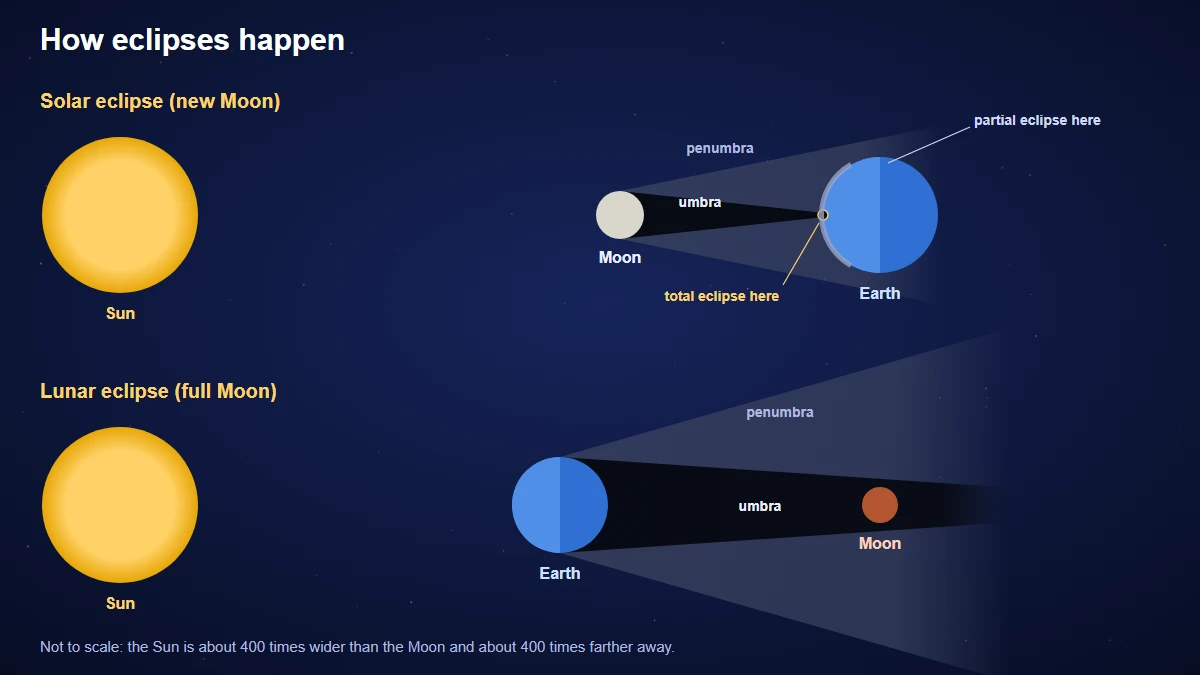
Earth and the Moon both cast long shadows into space, pointing directly away from the Sun.
An eclipse happens when one body passes into the other's shadow.
In a solar eclipse, the Moon passes between the Sun and Earth, and the Moon's shadow falls on part of Earth's surface.
This can only happen at new Moon, when the Moon lies in the Sun's direction.
In a lunar eclipse, Earth passes between the Sun and the Moon, and Earth's shadow falls on the Moon.
This can only happen at full Moon, when the Moon is on the opposite side of Earth from the Sun.
Each shadow has two parts: a dark inner cone called the umbra, where the Sun is completely blocked,
and a paler outer region called the penumbra,
where it is only partly blocked. Which part of the shadow is involved determines the type of eclipse.
Why Eclipses Do Not Happen Every Month
If the Moon orbited in exactly the same plane as Earth orbits the Sun,
we would see a solar eclipse at every new Moon and a lunar eclipse at every full Moon.
In reality, the Moon's orbit is tilted by about five degrees.
Most months, the new Moon passes slightly above or below the Sun, and the full Moon slips just above or below Earth's shadow.
Eclipses only occur when a new or full Moon happens near one of the two points where the Moon's orbit crosses Earth's orbital plane.
These windows, called eclipse seasons, come around roughly every six months, which is why eclipses tend to arrive in pairs,
a solar eclipse and a lunar eclipse about two weeks apart. Every year has at least two solar eclipses somewhere on Earth,
and usually two or more lunar eclipses when the subtle penumbral kind are counted. Eclipses also repeat in a long rhythm called the saros cycle,
about 18 years and 11 days.
Types of Solar Eclipses
- Total: The Moon completely covers the Sun's bright disk. The umbra traces a narrow path across Earth, usually no more than a couple of hundred kilometers wide, and only people inside that path see totality.
- Annular: The Moon is near the farthest point of its slightly oval orbit and looks a little too small to cover the Sun, leaving a brilliant ring of sunlight around it.
- Partial: The Moon covers only part of the Sun. Observers outside the central path of a total or annular eclipse see a partial eclipse, and some eclipses are only ever partial.
- Hybrid: A rare type that appears annular along part of its path and total along another.
Total solar eclipses depend on a remarkable coincidence.
The Sun is about 400 times wider than the Moon but also about 400 times farther away,
so the two appear nearly the same size in our sky.
Because the path of totality is so narrow, any one location sees a total eclipse only rarely,
on average once every few centuries, which is why many people travel to see one.
What Happens During a Total Solar Eclipse
A total eclipse begins with a long partial phase, often an hour or more, as the Moon gradually covers the Sun.
At first, little seems to change.
As the Sun becomes a thin crescent, the light turns strange and flat, shadows sharpen and the air cools noticeably.
In the final moments before totality, faint rippling shadow bands may race across the ground,
and the last sunlight shines through valleys on the Moon's edge as bright points called Baily's beads.
A single brilliant point creates the famous diamond ring effect.
Then totality begins: the Sun's pearly outer atmosphere, the corona, appears around the black disk of the Moon,
bright planets and stars come out, and the horizon glows with sunset colors in every direction.
Animals often behave as if night were falling.
Totality usually lasts a few minutes at most; the longest possible is about seven and a half minutes.
Then the diamond ring reappears on the other side and the partial phases repeat in reverse.
Types of Lunar Eclipses
Lunar eclipses are gentler and much easier to see, because they are visible from the entire night side of Earth,
wherever the Moon is above the horizon.
In a total lunar eclipse, the whole Moon enters Earth's umbra. It does not disappear.
Instead, it turns shades of orange, red or brown,
because Earth's atmosphere bends a little sunlight into the shadow and filters out most of the blue.
In effect, the Moon is lit by all of Earth's sunrises and sunsets at once.
The exact color and darkness vary with dust and clouds in our atmosphere.
Totality can last up to about an hour and three quarters, and the whole event, including partial phases, several hours.
In a partial lunar eclipse, only part of the Moon enters the umbra, leaving a dark bite on one side.
In a penumbral eclipse, the Moon passes only through the pale outer shadow and dims so slightly that many casual observers never notice.
How to Watch a Solar Eclipse Safely
Looking at the Sun without proper protection can permanently damage your eyes, and the damage can happen without pain.
During any partial or annular phase, even a thin sliver of the Sun is dangerously bright.
Follow these rules without exception:
- Never look at the Sun without certified eclipse glasses or a handheld solar viewer that meets the international standard for direct solar viewing, known as ISO 12312-2. Buy from a reputable source.
- Inspect your glasses before use. If the filters are scratched, punctured or torn, throw them away.
- Ordinary sunglasses, even very dark ones, are not safe. Neither are homemade filters such as smoked glass or exposed film.
- Never look at the Sun through binoculars, a telescope or a camera unless a certified solar filter is securely fitted over the front of the instrument. Eclipse glasses alone do not protect you from the concentrated light of optics.
- Supervise children closely and make sure their glasses fit snugly.
- Only during totality itself, when the Moon completely covers the Sun and only if you are inside the path of totality, is it safe to look without protection. Put your glasses back on the instant the Sun begins to reappear.
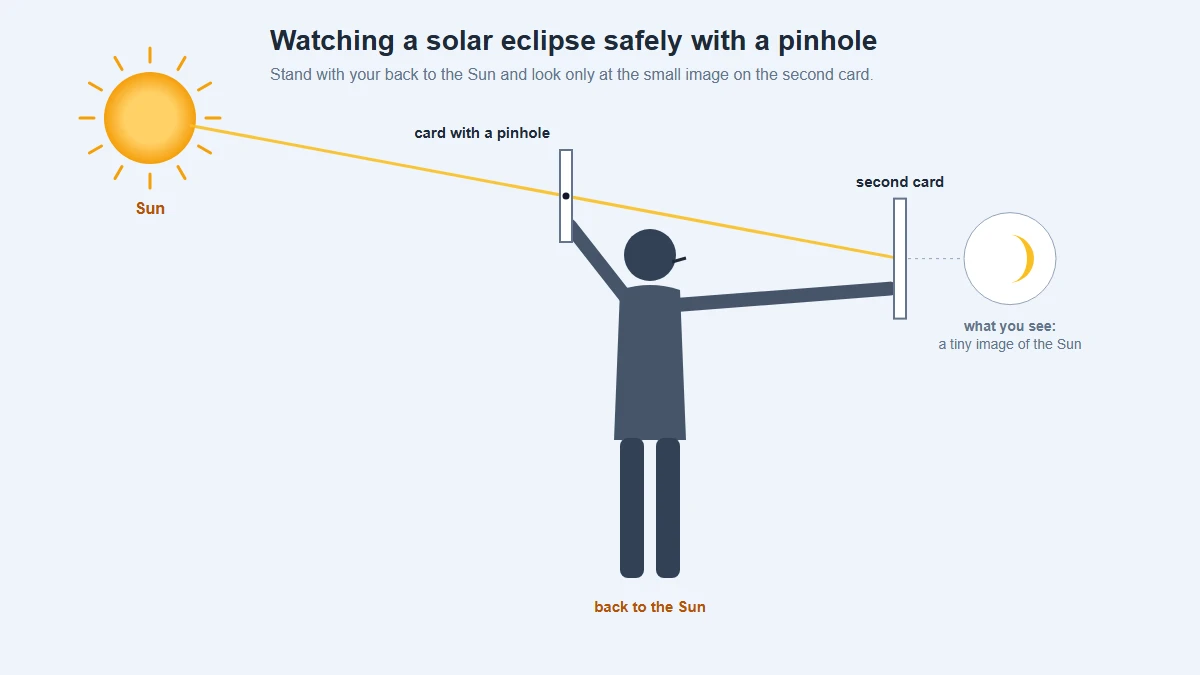
For a safe, indirect view, try pinhole projection.
Poke a small hole in a card and let sunlight pass through it onto a second card or the ground,
with your back to the Sun. You will see a small image of the eclipsed Sun.
The gaps between tree leaves or the holes in a kitchen colander produce dozens of little crescents on the ground.
Never look at the Sun through the pinhole itself.
How to Watch a Lunar Eclipse
A lunar eclipse needs no special equipment and is completely safe to look at directly with your eyes, binoculars or a telescope.
Find a spot with a view of the Moon, dress for the hour and watch the shadow creep across the lunar surface.
Binoculars bring out the subtle colors and the stars that reappear around the darkened Moon.
Astronomers sometimes rate the darkness and color of totality on a five-step scale, from almost invisible to bright copper-orange,
which makes a fun observation to record.
Finding Out About Upcoming Eclipses
Eclipses are predicted with great precision years in advance.
National space agencies, observatories and planetarium apps publish maps showing where each eclipse will be visible,
the timing of each phase and whether it will be total, annular or partial from your location.
Check a reliable source well ahead of time, especially if you hope to travel to a path of totality.
Plan Ahead, Stay Safe
Lunar eclipses are the easy ones: find out when the next one is visible from your area, step outside and enjoy the slow transformation.
Solar eclipses take more planning and strict safety habits, but a total solar eclipse is one of the most breathtaking sights in nature.
Get certified eclipse glasses, protect your eyes and any optics, and you will be ready when the Moon and Sun line up.
Sources and Further Reading
This article was reviewed by the LoudComet editorial team against the official sources below. Mission details and sky events change over time, so check the agencies' own pages for the latest information.
- How to View a Solar Eclipse Safely, American Astronomical Society: ISO 12312-2 eclipse glasses, discarding damaged filters, no sunglasses, filtered optics, supervising children and the totality-only rule.
- Indirect Solar Viewing: Pinhole & Optical Projection, American Astronomical Society: Pinhole projection with your back to the Sun, colander and tree-leaf crescents, and never looking at the Sun through the pinhole.
- Eclipses and the Moon, NASA Science: The Moon's 5-degree orbital tilt, eclipses only at new or full Moon, umbra and penumbra, and why the eclipsed Moon turns red.
- Types of Solar Eclipses, NASA Science: Total, annular, partial and hybrid solar eclipses, and why the Moon looks too small to cover the Sun in an annular eclipse.
- Eclipse Viewing Safety, NASA Science: Glasses come off only while the Moon fully covers the Sun and go back on as it reappears; annular eclipses need filters throughout.