
Anúncios
The Moon is the easiest object in the sky to find, yet its changing shape puzzles plenty of people.
Why is it a thin sliver one week and a bright disc the next?
Why is it sometimes up in the middle of the afternoon?
Anúncios
And why does a crescent look different in Sydney than in Chicago?
The answers are simpler than they seem. Once you understand one basic idea, you can predict the Moon's shape,
where it will be and when it will rise, and use that knowledge to plan better nights under the stars.
The Simple Reason the Moon Has Phases
The Moon makes no light of its own.
It shines by reflecting sunlight, and at any moment the Sun lights up exactly half of it, the half facing the Sun.
The other half is in darkness.
As the Moon orbits Earth, we see that sunlit half from a changing angle.
When the Moon sits roughly between Earth and the Sun, the lit half faces away from us and we see almost nothing.
When the Moon is on the far side of Earth from the Sun, we see the entire lit half as a full Moon.
In between, we see part of the lit half and part of the dark half, and that mix creates crescents,
half Moons and the bulging shapes called gibbous.
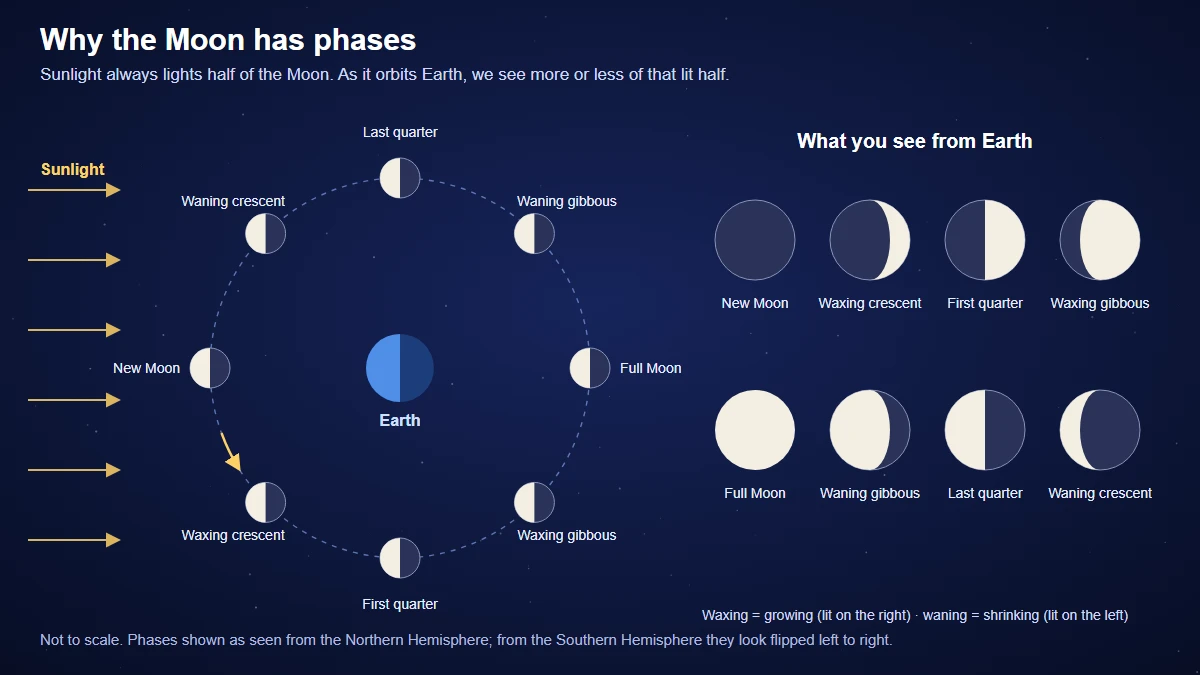
A common misconception is that phases are caused by Earth's shadow. They are not.
Earth's shadow falls on the Moon only during a lunar eclipse, which is a separate and much rarer event.
The Eight Phases at a Glance
The cycle is usually divided into eight named phases.
The rising times below are approximate and shift with the season and your latitude, but the pattern holds everywhere:
| Phase | What you see | Rises around | When to look |
|---|---|---|---|
| New Moon | Nothing; the lit side faces away | Sunrise | Not visible; best nights for faint stars |
| Waxing crescent | A thin, growing sliver | Mid-morning | Low in the west after sunset |
| First quarter | Half the disc lit | Around noon | Afternoon and evening, setting near midnight |
| Waxing gibbous | More than half, growing | Mid-afternoon | Evening and much of the night |
| Full Moon | The whole disc lit | Sunset | All night long |
| Waning gibbous | More than half, shrinking | Mid-evening | Late night and early morning |
| Last quarter | The other half lit | Around midnight | After midnight and into the morning |
| Waning crescent | A thin, shrinking sliver | A few hours before dawn | Low in the east before sunrise |
The quarter phases often confuse people because they look like half Moons. The name refers to timing,
not shape: first quarter comes a quarter of the way through the cycle and last quarter three quarters of the way through.
Waxing, Waning and the Monthly Rhythm
Waxing means growing and waning means shrinking.
From new Moon to full Moon the lit portion grows; from full back to new it shrinks.
The full cycle, from one new Moon to the next, takes about 29.5 days.
The Moon actually completes one orbit relative to the stars in about 27.3 days.
The extra two days come from Earth's own motion around the Sun: by the time the Moon has gone around once,
the Sun has shifted, and the Moon has to travel a little farther to line up the same way again.
Because the Moon moves eastward along its orbit, it rises later each day, by about 50 minutes on average.
The delay varies with the season and your latitude.
Around the autumn equinox at mid-latitudes, the full Moon rises only a little later on successive evenings,
giving several bright evenings in a row, a pattern long associated with the Harvest Moon.
Why Your Hemisphere Changes the View
People in the Northern and Southern Hemispheres see the same Moon, but upside down relative to each other,
because they are standing on opposite sides of a round planet.
In the Northern Hemisphere, a waxing Moon is lit on the right and a waning Moon on the left.
In the Southern Hemisphere it is the reverse: waxing on the left, waning on the right.
A handy trick in the north is the letters D, O and C.
A waxing Moon lit on the right looks like a D, the full Moon an O and a waning Moon a C.
In the south the letters run the other way.
Near the equator, the crescent tends to lie on its back, like a bowl or a smile, rather than standing upright.
The same flip applies to the Moon's surface features.
The dark patches that some northern observers see as a face appear rotated for southern viewers,
and cultures around the world have seen very different pictures in them, from a face to a rabbit.
Earthshine and the Daytime Moon
Look closely at a thin crescent and you will often see the rest of the disc glowing faintly.
This is earthshine: sunlight reflected off Earth onto the Moon's night side and back to your eyes.
Leonardo da Vinci described the correct explanation more than 500 years ago.
Earthshine is best a few days before or after new Moon.
The Moon also spends a lot of time in the daytime sky, especially around the quarter phases.
A first-quarter Moon is easy to spot in the afternoon and a last-quarter Moon in the morning.
When looking for the Moon in daylight, keep the Sun out of your view, and never look directly at the Sun.
Supermoons, Blue Moons and Other Names
The Moon's orbit is slightly oval, so its distance from Earth varies.
A full Moon near its closest point is popularly called a supermoon.
It appears up to about 14 percent wider and roughly 30 percent brighter than a full Moon at its farthest,
a real but modest difference that is hard to judge by eye.
A Blue Moon has nothing to do with color.
In common use, it is the second full Moon in a calendar month;
an older definition calls it the third of four full Moons in a single season.
Either way, it happens only about every two to three years.
Many traditional names for full Moons, such as the Harvest Moon, come from seasonal calendars and farming traditions.
Meanwhile, the huge orange Moon you sometimes see near the horizon is mostly an illusion.
Its actual size barely changes as it rises; your brain simply judges it as larger next to trees and buildings.
The orange color is real, caused by moonlight passing through more atmosphere.
Use the Phases to Plan Your Nights
Phases matter for every kind of stargazing. A few practical rules:
- For faint galaxies, nebulae and the Milky Way, observe in the week around new Moon.
- For lunar detail, observe away from full Moon, when shadows along the line between day and night make craters and mountains stand out.
- For evening observing without moonlight, the days after full Moon work well, since the Moon does not rise until later at night.
- For meteor showers, check the phase first; a bright Moon near the peak hides most meteors.
Frequently Asked Questions
Why don't we get eclipses every month?
The Moon's orbit is tilted by about five degrees relative to Earth's orbit around the Sun.
Most months, the new Moon passes a little above or below the Sun and the full Moon a little above or below Earth's shadow.
Eclipses only happen when a new or full Moon falls near the points where the two orbits cross.
Why do we always see the same side of the Moon?
The Moon spins once on its axis in the same time it takes to orbit Earth, so the same face always points toward us.
Slight wobbles, called libration, let us see a little around the edges over time.
Is there really a dark side of the Moon?
Not permanently. The far side, which we never see from Earth, gets just as much sunlight as the near side.
At new Moon, when our side is dark, the far side is fully lit.
Watch It Change
The best way to understand the phases is to follow them.
For one month, step outside each evening, note where the Moon is and sketch its shape.
You will see it grow, rise later each day and move steadily eastward against the stars, and the whole cycle will make intuitive sense.
Sources and Further Reading
This article was reviewed by the LoudComet editorial team against the official sources below. Mission details and sky events change over time, so check the agencies' own pages for the latest information.
- Moon Phases, NASA Science: The Sun always lights half the Moon; the eight phases repeat every 29.5 days; the quarter Moons rise or set around midday and midnight.
- Phases of the Moon and Percent of the Moon Illuminated, U.S. Naval Observatory: Definitions of new, first quarter, full and last quarter Moon, why the quarters are named for timing, and the full Moon rising at sunset.
- What Are the Moon's Phases?, NASA Space Place: From the Northern Hemisphere the waxing crescent is lit on the right and the waning crescent on the left.
- Eclipses and the Moon, NASA Science: The Moon's orbit is tilted about 5 degrees, so most new and full Moons miss the Sun and Earth's shadow.
- Supermoons, NASA Science: A full Moon near perigee can look up to 14 percent bigger and 30 percent brighter than the faintest full Moon, which is hard to notice.