
Anúncios
Most pictures of the solar system show the planets lined up neatly beside the Sun, almost touching, like beads on a string.
Those diagrams are useful for learning the order of the planets,
but they hide the most astonishing thing about our cosmic neighborhood: how enormous and how empty it is.
Anúncios
Numbers like 150 million kilometers or 4.5 billion kilometers are hard to feel.
So instead of piling up zeros, this guide uses a scale model you could lay out on a real street,
the travel time of light and some everyday comparisons to make the distances finally click.
Why Solar System Diagrams Mislead You
There is a good reason textbooks cheat.
If you drew the planets at their true sizes and true distances on the same page, you could not see them.
On a page wide enough to reach Neptune,
Earth would be far smaller than the period at the end of this sentence,
and even giant Jupiter would be too small to see.
So diagrams enlarge the planets and squash the gaps between them. That creates a false impression of a crowded system.
In reality, the planets are tiny specks separated by vast stretches of nearly empty space.
The Astronomical Unit: A Better Measuring Stick
Astronomers make the numbers manageable with the astronomical unit, or AU.
One AU is the average distance between Earth and the Sun, about 150 million km (93 million miles).
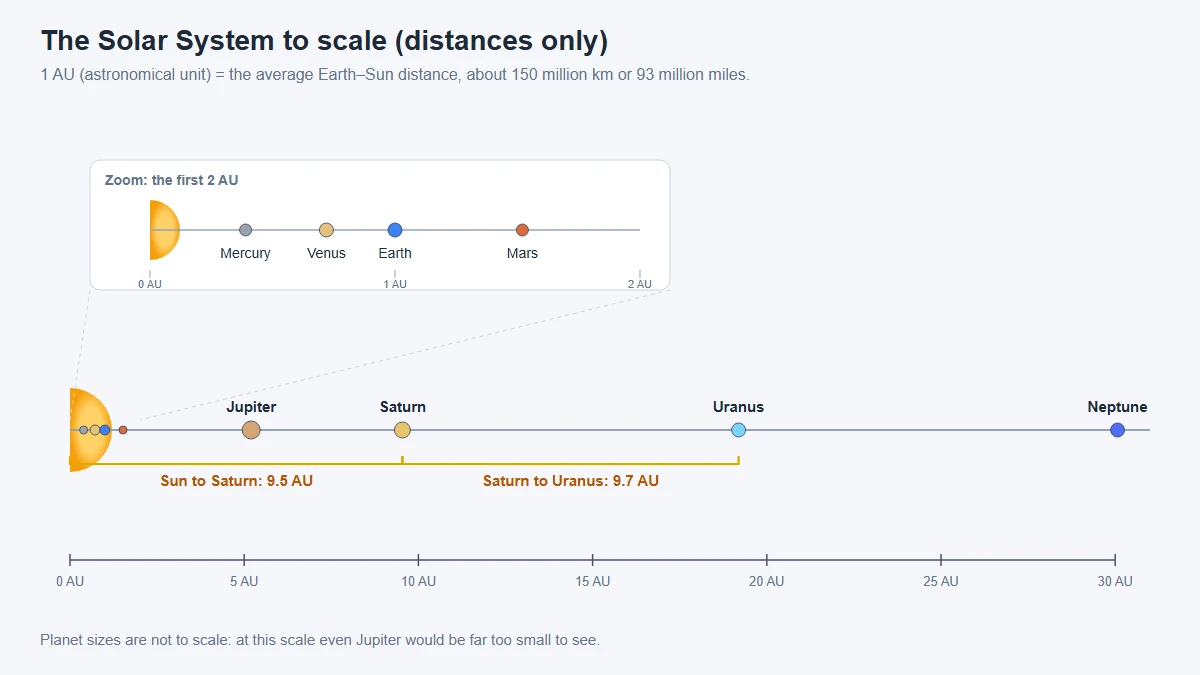
Using it, the planets line up like this: Mercury is about 0.4 AU from the Sun, Venus about 0.7,
Earth 1, Mars about 1.5, Jupiter about 5.2, Saturn about 9.5, Uranus about 19 and Neptune about 30.
Those numbers reveal a pattern that diagrams hide.
The four rocky planets are packed close to the Sun, all within about one and a half AU.
Beyond them, the gaps grow dramatically.
The distance from Saturn to Uranus alone is greater than the distance from the Sun to Saturn.
Build a Solar System You Can Walk
Here is a scale model that works on a real street or path.
Shrink the Sun to a ball about 20 cm (8 inches) across, roughly the size of a volleyball.
At that scale, Earth is about the size of a pinhead, and everything else falls into place:
| Object | Real average distance from the Sun | Distance in the model | Size in the model |
|---|---|---|---|
| Mercury | About 58 million km (36 million miles) | About 8 m (27 feet) | A tiny speck, under 1 mm |
| Venus | About 108 million km (67 million miles) | About 15 m (50 feet) | A pinhead |
| Earth | About 150 million km (93 million miles) | About 21 m (70 feet) | A pinhead |
| Mars | About 228 million km (142 million miles) | About 33 m (110 feet) | A small speck, about 1 mm |
| Jupiter | About 778 million km (484 million miles) | About 110 m (370 feet) | A grape, about 2 cm |
| Saturn | About 1.4 billion km (890 million miles) | About 205 m (670 feet) | A slightly smaller grape |
| Uranus | About 2.9 billion km (1.8 billion miles) | About 410 m (1,350 feet) | A small bead, about 7 mm |
| Neptune | About 4.5 billion km (2.8 billion miles) | About 650 m (2,100 feet) | A small bead, just slightly smaller |
In this model, the Moon is a grain of sand orbiting only about 5 cm (2 inches) from the pinhead Earth.
No human has ever traveled much beyond that short gap.
Neptune, meanwhile, sits more than half a kilometer from the ball,
and the nearest star beyond the Sun would be thousands of kilometers away,
farther than the distance from New York to London.
Measuring Distance in Light
Light is the fastest thing in the universe, traveling about 300,000 km (186,000 miles) every second.
It could circle Earth more than seven times in one second.
Yet even light takes a while to cross the solar system:
- The Moon: a little over one second.
- The Sun: about 8 minutes and 20 seconds. The sunlight you see left the Sun that long ago.
- Mars: from about 3 to about 22 minutes, depending on where Earth and Mars are in their orbits.
- Jupiter: between about half an hour and just under an hour.
- Neptune: about 4 hours.
- The nearest star beyond the Sun: a little over 4 years.
Those delays are very real for space missions.
Engineers cannot steer a Mars rover with a joystick, because every command takes minutes to arrive.
Rovers must be given instructions in advance and trusted to carry them out on their own.
How Long Would It Take to Get There?
Travel times make the scale even more personal.
If you could drive a car to the Sun at a steady 100 km/h (about 60 mph), never stopping,
the trip would take more than 170 years. A jet airliner would need roughly 19 years.
Spacecraft are much faster, but the distances still stretch missions across years.
NASA's New Horizons, one of the fastest spacecraft ever launched, took about nine and a half years to reach Pluto.
Voyager 2 launched in 1977 and did not fly past Neptune until 1989, twelve years later,
even with gravity boosts from the planets it passed along the way.
Beyond the Planets
Neptune is not the end of the solar system.
The icy Kuiper Belt stretches from about 30 to about 50 AU.
Farther out, around 120 AU, the solar wind finally gives way to the thin gas between the stars.
Voyager 1 crossed that boundary in 2012, becoming the first spacecraft to reach interstellar space.
Even that is only the beginning.
The Oort Cloud, a vast shell of icy bodies that has never been observed directly,
is thought to extend from a few thousand AU out to perhaps 100,000 AU.
The nearest star, Proxima Centauri, lies about 4.2 light-years away, roughly 270,000 AU.
In our volleyball model, the Oort Cloud's outer reaches would lie some 2,000 km away.
Try It Yourself
Building the walking model is a great activity for families, classes or astronomy clubs. Here is a simple plan:
- Choose a long, straight, safe path, such as a park trail, quiet road or beach, at least 650 m (about 0.4 mile) long.
- Place a ball about 20 cm across at the start to stand in for the Sun.
- Mark each planet's spot using the distances in the table, counting paces if you do not have a measuring tape.
- Stick the planets, from pinheads to grapes and small beads, onto cards so people can see how small they are.
- Walk the whole route together, pausing at each planet, then look back at the tiny Sun from Neptune.
Seeing the Sky With New Eyes
Once you have walked the solar system, the night sky looks different.
That bright point of Jupiter is a giant world hundreds of millions of kilometers away, and the stars behind it are unimaginably farther still.
Understanding the scale does not make space feel smaller. It makes every planet you spot feel like a genuine achievement.
Sources and Further Reading
This article was reviewed by the LoudComet editorial team against the official sources below. Mission details and sky events change over time, so check the agencies' own pages for the latest information.
- Solar System: Facts, NASA Science: The astronomical unit of about 150 million km, the Kuiper Belt beyond Neptune and the Oort Cloud reaching about 100,000 AU.
- Solar System model on a city map, IAU astroEDU (International Astronomical Union): Building a walkable scale model of the solar system, using one scale factor so tiny planets sit far apart.
- Voyager Interstellar Mission, NASA Science: Voyager 1 crossing into interstellar space in 2012, about 122 AU from the Sun.
- New Horizons, NASA Science: New Horizons' journey of more than nine years to Pluto, and the Kuiper Belt spanning about 30 to 50 AU.