
Anúncios
The Moon is the one world beyond Earth that everyone has seen in detail.
Even without a telescope you can pick out its dark patches,
watch it change shape through the month and see it light up a beach or a snowy field at night.
Anúncios
Behind that familiar face lies a dramatic history and a surprisingly strong influence on our planet.
Here is how the Moon most likely formed, what its surface can tell us,
why it always shows us the same side and how it affects tides, days and the stability of Earth itself.
Meet Our Moon
The Moon is about 3,475 km (2,160 miles) across, roughly a quarter of Earth's width.
That makes it unusually large compared with its planet; no other planet has a moon so big relative to its own size.
It circles Earth at an average distance of about 384,000 km (239,000 miles), so its light takes just over a second to reach us.
Its gravity is about one sixth of Earth's, which is why Apollo astronauts could bound across the surface with heavy spacesuits and backpacks.
The Moon has no real atmosphere, no liquid water on its surface and no global magnetic field today.
How the Moon Formed
The leading explanation is called the giant-impact hypothesis. About 4.5 billion years ago, not long after Earth formed,
a body roughly the size of Mars is thought to have struck the young Earth a glancing blow.
The collision threw a huge amount of molten and vaporized rock into orbit, and that debris gradually gathered into the Moon.
Several lines of evidence support this idea:
- Moon rocks brought back by the Apollo astronauts are strikingly similar in chemical makeup to rocks from Earth's mantle.
- The Moon has only a small iron core, which fits the idea that it formed mostly from rocky outer material rather than metal.
- Its oldest rocks show that the young Moon was covered by a global ocean of magma, which suggests it formed hot and fast.
- Computer simulations show that a large, angled impact can produce a moon with roughly the right size and orbit.
The hypothesis still has open questions,
especially why the Moon and Earth are so alike chemically if much of the Moon came from the impacting body.
Scientists continue to test variations of the idea, but a giant collision remains the best-supported explanation.
Reading the Lunar Surface
With no wind, rain or plate tectonics to erase it, the Moon's surface preserves billions of years of history.
Its face is a patchwork of two main kinds of terrain.
The Dark Seas
The dark areas are called maria, Latin for "seas," because early observers thought they might be bodies of water.
They are actually vast plains of dark volcanic rock called basalt.
Lava welled up and flooded giant impact basins several billion years ago, then cooled into the smooth,
dark patches that form the familiar "face" many people see.
The Bright Highlands and Craters
The lighter areas are the highlands, older terrain made of pale rock and packed with overlapping craters.
Some young craters, such as Tycho, are surrounded by bright rays of material splashed outward by the impact, which stand out beautifully near full Moon.
A Surface Without Weather
The ground is covered in regolith, a layer of fine dust and broken rock created by countless impacts.
Because there is no weather, the footprints left by astronauts could last for a very long time.
Without an atmosphere to spread heat, the surface swings from above boiling point in sunlight to far below freezing at night.
Some craters near the poles never see sunlight, and several spacecraft have detected water ice hidden in their shadows.
That ice could one day be a valuable resource for explorers.
Why We Always See the Same Face
The Moon spins on its axis exactly once for every trip around Earth, about 27 days.
This match, called tidal locking, developed as Earth's gravity gradually slowed the Moon's early spin.
As a result, the same hemisphere always faces us.
The side we never see from Earth is often called the "dark side," but that is a myth.
It receives just as much sunlight as the near side; it is simply out of our view.
It was first photographed by the Soviet spacecraft Luna 3 in 1959,
which revealed a surface with far fewer dark maria than the side facing Earth.
A slight wobble in the Moon's motion, called libration, lets us peek a little way around its edges over time,
so from Earth you can eventually see about 59 percent of its surface.
How the Moon Shapes Life on Earth
Tides
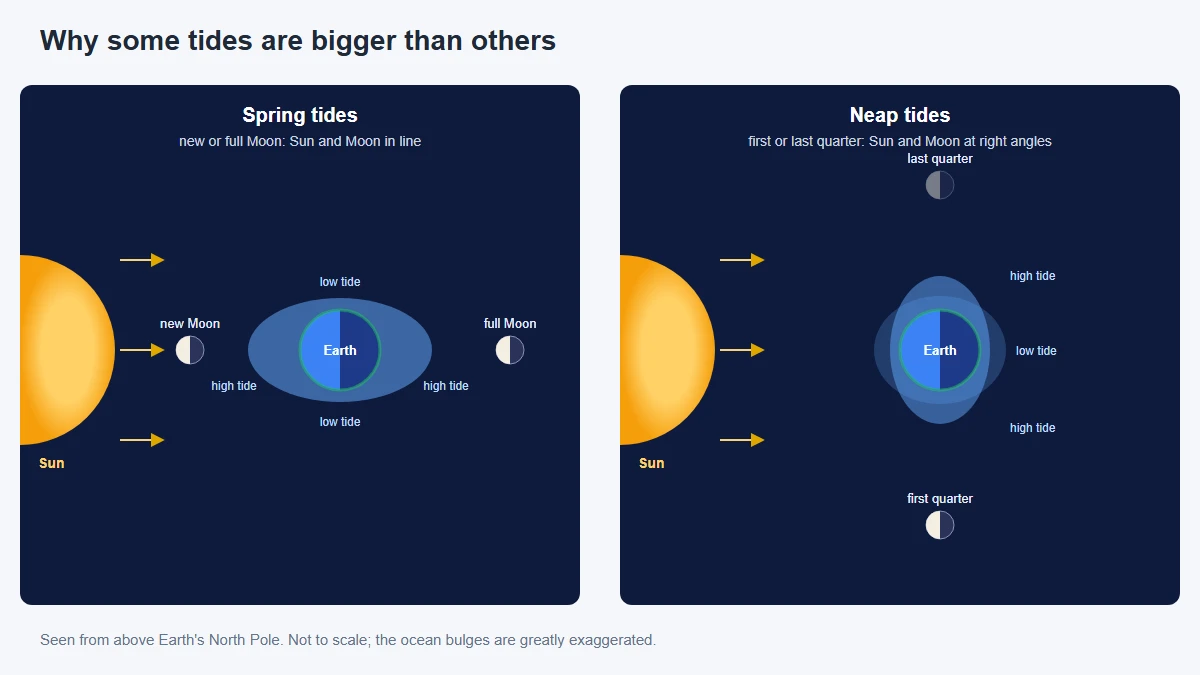
The Moon's gravity pulls slightly harder on the side of Earth facing it than on the far side.
That difference stretches the oceans into two bulges, and as Earth rotates beneath them,
most coastlines get two high tides and two low tides roughly every day. The Sun adds a smaller effect.
When Sun and Moon line up at new and full Moon, tides are larger, and when they pull at right angles, tides are gentler.
A Steadier Planet
Earth's axis is tilted, and that tilt gives us seasons.
Many scientists think the Moon's gravity helps keep that tilt relatively stable over long periods, which in turn helps keep Earth's climate from swinging wildly.
Without such a large moon, the tilt could wander much more.
Longer Days and a Retreating Moon
Tides also act as a brake. Friction between the moving oceans and the seafloor slowly slows Earth's spin,
lengthening our day by a tiny fraction of a second over many thousands of years.
In exchange, the Moon gains energy and drifts away by about 3.8 cm (1.5 inches) per year,
a rate measured by bouncing lasers off reflectors left on the surface by Apollo astronauts.
As for folklore, popular claims that the full Moon changes human behavior or birth rates have not held up well in careful studies.
Footsteps on the Moon
The Moon is the only other world humans have visited. Between 1969 and 1972, six Apollo missions landed, and twelve astronauts walked on the surface.
They set up experiments,
drove electric rovers on the later missions and brought back about 380 kg (840 pounds) of rock and soil,
samples that are still studied today and underpin much of what we know about the Moon's age and origin.
Tips for Exploring the Moon Tonight
- Skip the full Moon at first. When the Moon is full, sunlight hits it head-on and shadows vanish. Features look flat.
- Follow the terminator. The line between day and night on the Moon shows long shadows that make craters and mountains pop out in striking relief.
- Start with binoculars. Even a basic pair reveals the maria, bright craters and the jagged edge of the terminator.
- Watch it change night by night. The terminator moves every evening, so the same area can look completely different a day later.
- Look for earthshine. A few days after new Moon, the dark part of a thin crescent glows faintly with sunlight reflected off Earth.
Keep Looking Up
The Moon is a record of the solar system's violent youth, a steady partner that shapes our tides and days,
and the easiest place to start exploring the sky.
Grab a pair of binoculars on the next clear evening near first quarter and spend a few minutes tracing its seas and craters.
It is time well spent.
Sources and Further Reading
This article was reviewed by the LoudComet editorial team against the official sources below. Mission details and sky events change over time, so check the agencies' own pages for the latest information.
- Moon Facts, NASA Science: The Moon's size, distance, one-sixth gravity, maria and highlands, tidal locking, polar ice and the Apollo samples.
- Moon Formation, NASA Science: The giant-impact explanation, the Apollo rock evidence, the magma ocean, the small core and the Moon's slow retreat.
- Tides, NASA Science: How the Moon's pull raises two ocean bulges, giving most coasts two high and two low tides a day.
- What Causes Tides, NOAA National Ocean Service: Why the Sun, though far more massive, raises tides only about half as strong as the Moon's.
- What are spring and neap tides?, NOAA National Ocean Service: Larger spring tides at new and full Moon, and gentler neap tides when the Sun and Moon are at right angles.