
Anúncios
For most of history,
a bright comet appearing in the sky was a shock: a ghostly smudge with a streaming tail that seemed to come from nowhere.
Today we know comets are not omens but some of the oldest and most pristine objects in the solar system.
Anúncios
They spend most of their lives frozen and invisible in the far outer reaches,
then flare into view when their orbits bring them close to the Sun.
Here is what comets are made of, why they grow tails, where they come from,
what spacecraft have learned by chasing them and how to make the most of one when it appears.
What a Comet Really Is
At the heart of every comet is a solid nucleus, usually just a few kilometers across.
It is a loose mixture of ices, including frozen water, carbon dioxide and carbon monoxide, mixed with dust, rock and carbon-rich compounds.
Astronomers once described comets as "dirty snowballs," though many turned out to be more dust than ice, closer to icy dirtballs.
Despite all that ice, a comet's nucleus is one of the darkest objects in the solar system.
Its surface is coated with a crust of dark dust and organic material that reflects only a small fraction of the sunlight that falls on it.
Far from the Sun, a comet is nearly impossible to see.
How a Comet Comes to Life
As a comet approaches the Sun, its surface warms up.
Ices begin to turn directly from solid to gas, a process called sublimation, and the gas carries dust out with it.
This material forms a glowing cloud around the nucleus called the coma,
which can grow larger than a planet even though the nucleus inside is tiny.
Two Kinds of Tail
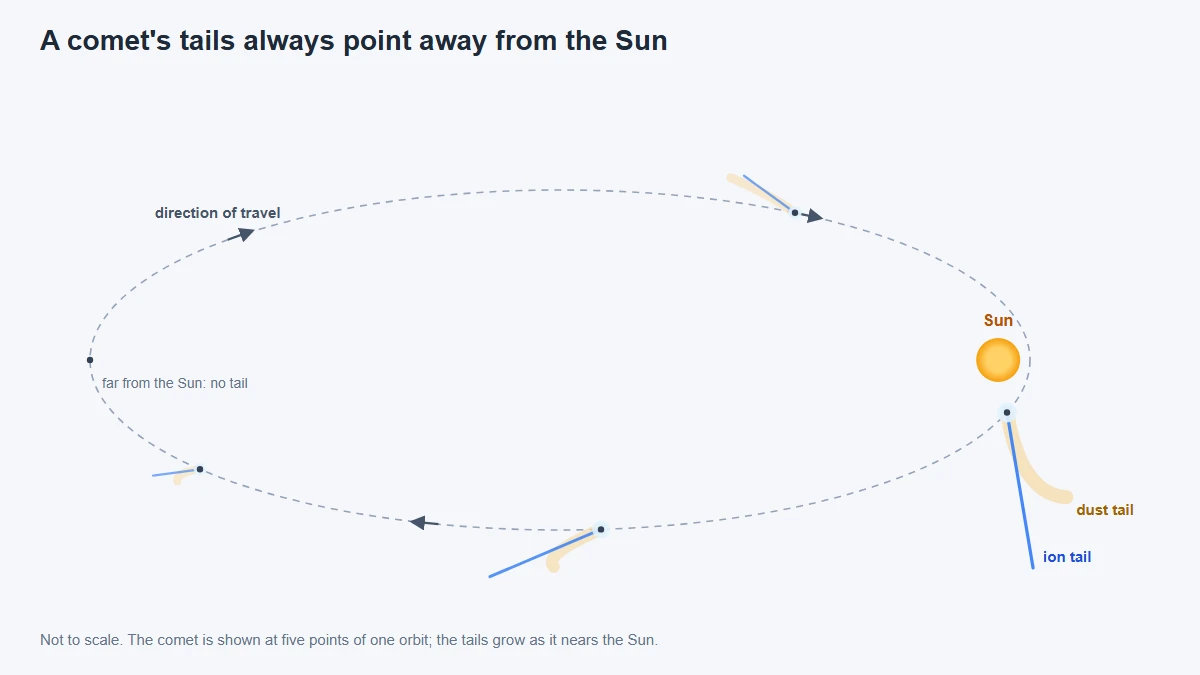
Pressure from sunlight and the solar wind then pushes material away from the coma, forming tails that can stretch for tens of millions of kilometers.
Many comets show two distinct tails:
- The dust tail is made of tiny grains pushed gently by the pressure of sunlight. It shines by reflected sunlight, often looks yellowish-white and curves gracefully along the comet's path.
- The ion tail is made of electrically charged gas swept outward by the solar wind. It glows with its own faint blue light and points almost straight away from the Sun, often looking narrow and streaky.
Because both tails are pushed outward by the Sun, they always point generally away from it.
That means a comet heading back out to the outer solar system actually travels tail first.
Where Comets Come From
Comets are grouped by how long they take to orbit the Sun, which also hints at where they come from.
Short-period comets complete an orbit in less than about 200 years.
Most are thought to come from the Kuiper Belt and the scattered region beyond Neptune,
and they tend to orbit near the same plane as the planets.
Many of them have orbits shaped by close encounters with Jupiter.
Long-period comets can take thousands or even millions of years for a single orbit, and they arrive from every direction in the sky.
That pattern led astronomers to propose the Oort Cloud, a vast, distant shell of icy bodies surrounding the solar system.
Passing stars and the gravity of our galaxy occasionally nudge one of them inward, sending it on a long fall toward the Sun.
Famous Comets Through History
The most famous of all is Halley's Comet, which returns to the inner solar system roughly every 76 years.
In 1705, Edmond Halley calculated that comets seen in earlier centuries were the same object and predicted its return,
which proved that at least some comets follow regular orbits. Its most recent visit was in 1986.
Some comets have caused alarm.
In 1910, Earth passed through the tail of Halley's Comet, and swindlers sold "comet pills" to frightened buyers.
The tail's gas was so thin that it posed no danger at all. Other comets are remembered for their beauty.
Comet Hale-Bopp, in 1997, stayed visible to the naked eye for well over a year, one of the longest spans on record.
Not every comet belongs to us, either. In 2019,
astronomers discovered a comet called 2I/Borisov traveling on a path that showed it had come from another star system,
the first interstellar comet ever identified.
Spacecraft That Chased Comets
Close encounters have transformed what we know about comets:
- A small fleet of spacecraft met Halley's Comet in 1986. The closest, Europe's Giotto, returned the most detailed images of a comet's nucleus seen up to that time, revealing a dark, potato-shaped body with jets of gas.
- NASA's Stardust collected dust from Comet Wild 2 and returned it to Earth in 2006, delivering the first samples ever brought back from a comet.
- NASA's Deep Impact fired a projectile into Comet Tempel 1 in 2005 to study the material beneath its surface.
- The European Rosetta mission orbited Comet 67P/Churyumov-Gerasimenko from 2014 to 2016. Its small lander, Philae, made the first landing on a comet in 2014, and the orbiter watched the comet's activity rise and fall as it swung around the Sun.
Comets, Water and the Ingredients for Life
Because they formed in the cold outer solar system and have stayed frozen ever since, comets preserve material from the solar system's birth.
They contain water and a variety of carbon-based molecules, some of them building blocks used by living things.
That raises a fascinating question: did comets help deliver water and organic material to the young Earth?
Comets certainly struck our planet in its early history, but measurements of the water in several comets show chemical differences from Earth's oceans.
Many scientists now think asteroids supplied more of Earth's water, with comets possibly contributing a smaller share.
The full answer is still being worked out.
Comets also leave trails of dust along their orbits.
When Earth passes through one of these trails, the grains burn up in our atmosphere as a meteor shower.
The Perseids, for example, come from debris shed by Comet Swift-Tuttle.
How to Watch a Comet
Truly bright comets are rare and hard to predict.
Their brightness depends on how much gas and dust they release, and some fizzle while others surprise everyone.
When a promising comet is announced, these steps will help:
- Check reliable sources such as astronomy magazines, planetarium websites or sky apps for its position and expected brightness.
- Get away from city lights. A comet's tail is faint and spread out, and dark skies make an enormous difference.
- Use binoculars. They are often the best tool, showing the coma and tail together in a single view.
- Mind the Sun. Comets are often brightest when near the Sun, low in twilight. Wait until the Sun is fully below the horizon before using binoculars, and never look at the Sun without certified solar filters.
- Be patient. Let your eyes adjust to the dark for 20 to 30 minutes to see the tail at its best.
Waiting for the Next Great Comet
Somewhere in the outer solar system, a frozen nucleus is already falling toward the Sun,
and no one knows when the next spectacular comet will light up the sky.
Learn what to look for now, keep an eye on astronomy news, and when the next great one arrives,
you will be ready to enjoy it.
Sources and Further Reading
This article was reviewed by the LoudComet editorial team against the official sources below. Mission details and sky events change over time, so check the agencies' own pages for the latest information.
- Comet Facts, NASA Science: Comet nuclei, comas and two tails, short-period comets from the Kuiper Belt, long-period ones from the Oort Cloud, Stardust and Deep Impact.
- What Is a Comet?, NASA Space Place: The white, gently curving dust tail and the bluish ion tail that always points directly away from the Sun.
- Giotto overview, European Space Agency (ESA): Giotto's 1986 close flyby of Halley's Comet, revealing a very dark nucleus with bright jets of gas and dust.
- Rosetta, European Space Agency (ESA): Rosetta as the first mission to orbit a comet, follow it around the Sun and land on it.
- Eclipse Viewing Safety, NASA Science: Never looking at the Sun, or pointing binoculars near it, without special solar filters.