
Anúncios
Most maps of the solar system stop at Neptune.
That is where the planets end, but it is far from the edge of the Sun's family.
Beyond Neptune stretches a frozen frontier, first a broad belt of icy worlds and then, much farther out,
Anúncios
a vast cloud that may reach a good part of the way to the nearest stars.
These are the Kuiper Belt and the Oort Cloud.
One has been explored by spacecraft and cataloged by telescopes; the other has never been seen at all.
Here is what each region is, how astronomers know about them and why they matter for understanding comets and the birth of the planets.
The Kuiper Belt: A Frozen Disk Beyond Neptune
The Kuiper Belt is a thick, doughnut-shaped disk of icy bodies that begins near Neptune's orbit,
about 30 times Earth's distance from the Sun, and extends to around 50 times that distance.
In everyday units, that is roughly 4.5 to 7.5 billion km (2.8 to 4.6 billion miles) from the Sun.
It is sometimes compared with the asteroid belt, but it is far wider and far more massive,
and its members are made of rock and ices, such as frozen water, methane and ammonia, rather than mostly rock and metal.
Astronomers estimate that it holds hundreds of thousands of objects more than 100 km (60 miles) across, along with enormous numbers of smaller ones.
The belt is named after the astronomer Gerard Kuiper,
who discussed the possibility of such a region in the mid-twentieth century,
although others proposed similar ideas around the same time. For decades it was only a theory.
Then, in 1992, astronomers found the first Kuiper Belt object other than Pluto and Charon, and thousands more have been discovered since.
What Lives in the Kuiper Belt
Kuiper Belt objects are not all alike. Their orbits fall into a few main groups:
- Classical objects follow fairly circular, untilted orbits in the main body of the belt. Many of them appear to have stayed undisturbed since the solar system formed.
- Resonant objects are locked into steady rhythms with Neptune. Pluto is the best-known example: it orbits the Sun twice for every three orbits of Neptune, and other bodies that share this rhythm are nicknamed plutinos.
- Scattered objects travel on long, tilted, stretched orbits, likely flung outward by past encounters with Neptune. The dwarf planet Eris is one of them.
Many Kuiper Belt objects have a reddish color, thought to come from organic compounds altered by billions of years of radiation.
Several are large enough to be dwarf planets, including Pluto, Haumea and Makemake.
Arrokoth: A Glimpse of the Solar System's Building Blocks
After its famous flyby of Pluto in 2015, NASA's New Horizons spacecraft continued outward and, on January 1, 2019,
flew past a small Kuiper Belt object now named Arrokoth.
At the time, it was the most distant object ever explored up close.
Arrokoth turned out to be two flattened, reddish lobes joined gently at a narrow neck, about 35 km (22 miles) long in total.
The smooth connection suggests the two pieces came together slowly rather than in a violent crash.
That finding supports the idea that the first building blocks of planets formed when clouds of small particles collapsed gently under their own gravity.
The Oort Cloud: A Shell We Have Never Seen
Far beyond the Kuiper Belt, astronomers think the solar system is surrounded by the Oort Cloud,
a roughly spherical shell that may contain trillions of icy bodies.
Its inner edge may lie a couple of thousand times Earth's distance from the Sun,
and its outer reaches may extend to around 100,000 times that distance, well over a light-year away.
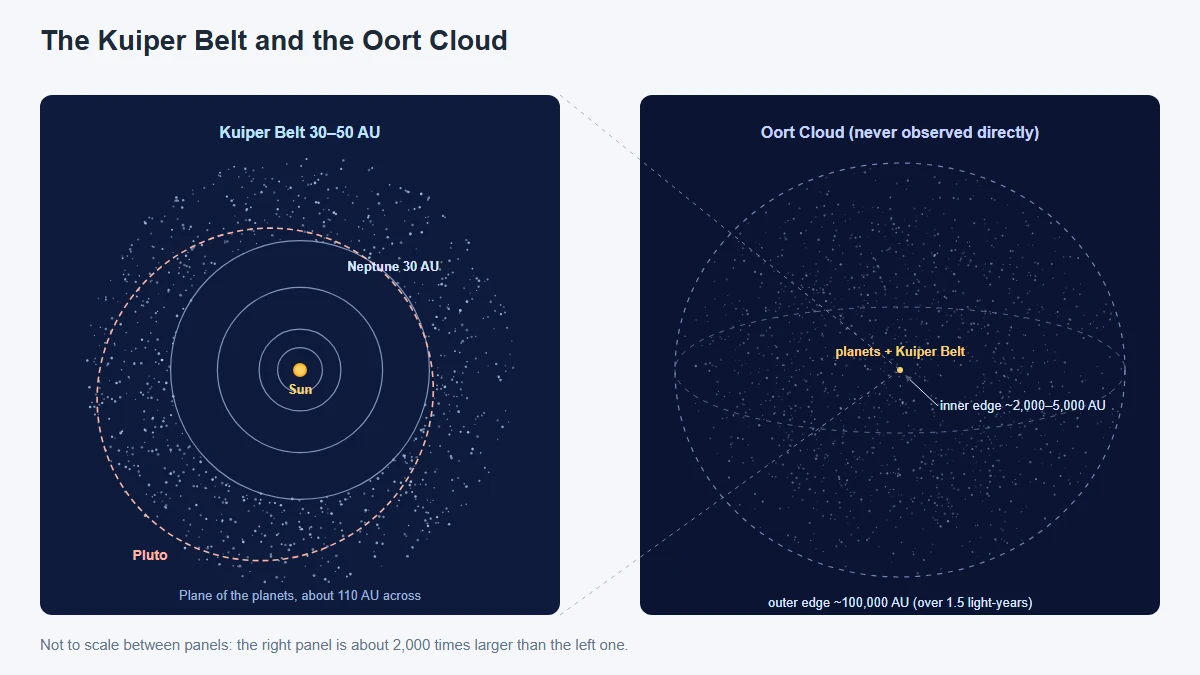
It is important to be clear: the Oort Cloud has never been observed directly.
Its members are too small, too dark and too far away for any telescope to detect.
Its existence is inferred from long-period comets.
In 1950, the Dutch astronomer Jan Oort noticed that these comets arrive from every direction and seem to begin their fall from similarly enormous distances.
A distant reservoir of icy bodies surrounding the Sun was the best explanation, and it remains the standard view.
The cloud is so remote that its objects are only loosely held by the Sun.
Passing stars and the gentle, steady pull of our galaxy can nudge them,
occasionally sending one on a long plunge toward the inner solar system as a new comet.
How These Regions Formed
Neither region is thought to be where its objects were born.
The leading picture is that both were shaped by the giant planets during the solar system's early history:
- Countless icy bodies formed in the outer disk of gas and dust around the young Sun, among and beyond the giant planets.
- As the giant planets grew and their orbits shifted, their gravity scattered many of these bodies.
- Some were thrown out of the solar system entirely, while others were flung onto enormous, distant orbits and later rounded into a shell by passing stars and the pull of the galaxy, forming the Oort Cloud.
- Bodies that remained beyond Neptune, or were pushed there by its outward migration, became the Kuiper Belt.
Some researchers have suggested that part of the Oort Cloud may even have been captured from other stars that formed alongside the Sun,
but that idea is still speculative.
Kuiper Belt vs. Oort Cloud
| Feature | Kuiper Belt | Oort Cloud |
|---|---|---|
| Shape | A thick, flattened disk | A roughly spherical shell |
| Distance from the Sun | About 30 to 50 times Earth's distance | Perhaps a few thousand to about 100,000 times Earth's distance |
| Observed directly? | Yes, thousands of objects are known | No, its existence is inferred |
| Comets it supplies | Many short-period comets | Long-period comets |
| Best-known members | Pluto, Haumea, Makemake, Arrokoth | None confirmed |
Frequently Asked Questions
How can scientists be confident the Oort Cloud exists?
Confidence comes from the orbits of long-period comets, which point back to a distant, spherical source.
No other explanation fits the evidence as well.
Still, its size, shape and number of objects are uncertain, and it remains a well-supported theory rather than something anyone has seen.
Is there a Planet Nine out there?
Nobody knows.
Some astronomers have proposed an undiscovered planet several times Earth's mass far beyond Neptune to explain why the orbits of certain distant objects appear to be grouped together.
Others argue that the grouping may be a result of which objects happen to have been discovered. Searches so far have not found such a planet,
and the idea remains unconfirmed.
Has any spacecraft reached the Oort Cloud?
No. Voyager 1, launched in 1977, crossed into interstellar space in 2012, but that boundary,
where the solar wind gives way to the gas between the stars, lies far closer than the Oort Cloud.
NASA has estimated that a spacecraft moving at Voyager's speed would need roughly 300 years just to reach the cloud's inner edge.
The Outer Edge of Home
The Kuiper Belt and Oort Cloud remind us that the solar system is much larger and stranger than the tidy row of planets in textbooks.
One region has already been explored by a spacecraft; the other is still a well-founded idea waiting for direct proof.
Both hold frozen clues to how our planetary system came to be.
Sources and Further Reading
This article was reviewed by the LoudComet editorial team against the official sources below. Mission details and sky events change over time, so check the agencies' own pages for the latest information.
- Kuiper Belt: Facts, NASA Science: The Kuiper Belt's doughnut shape from about 30 to 50 AU, its rock-and-ice objects, the resonant plutinos, the scattered disk and Arrokoth.
- Oort Cloud: Facts, NASA Science: The inferred Oort Cloud from about 2,000-5,000 to 100,000 AU, Jan Oort's 1950 comet argument and Voyager's roughly 300-year trip.
- New Horizons, NASA Science: New Horizons' Pluto flyby in 2015 and its January 1, 2019 flyby of Arrokoth, a two-lobed object about 35 km long.
- Hypothetical Planet X, NASA Science: The hypothetical Planet Nine, proposed to explain clustered distant orbits but not discovered and still debated.
- What Is a Comet?, NASA Space Place: Short-period comets coming from the Kuiper Belt and long-period comets from the far more distant Oort Cloud.