
Anúncios
For most of history, nobody knew whether other stars had planets.
Then, in the 1990s, astronomers found the first ones, and the trickle soon turned into a flood.
Scientists have since identified thousands of exoplanets, as planets beyond our solar system are called,
Anúncios
and the evidence suggests that most stars in our galaxy have at least one.
Yet almost none of those worlds have been photographed. So how do astronomers know they are there?
Here are the clever techniques behind exoplanet discoveries, what each one can reveal,
and how scientists combine them to learn what these distant worlds are like.
Why Exoplanets Are So Hard to See
A planet does not shine on its own.
It only reflects a little of its star's light and gives off a faint glow of heat.
In visible light, a star like the Sun outshines a planet like Earth by roughly ten billion times.
Trying to spot the planet is like trying to see a firefly next to a searchlight from hundreds of kilometers away.
Distance makes it worse. Even the nearest stars are light-years away,
so a planet and its star sit so close together in the sky that the star's glare swallows the planet.
For that reason, most exoplanets are found indirectly, through the effects they have on their stars.
A Brief History of the Hunt
The first confirmed exoplanets turned up in 1992 in an unexpected place: orbiting a pulsar, the rapidly spinning remnant of an exploded star.
Astronomers Aleksander Wolszczan and Dale Frail noticed tiny irregularities in the timing of its radio pulses, caused by planets tugging on it.
In 1995, Michel Mayor and Didier Queloz announced a planet circling 51 Pegasi, an ordinary Sun-like star.
To everyone's surprise, it was a giant planet orbiting so close to its star that its year lasted just over four days.
The discovery earned them a share of the 2019 Nobel Prize in Physics.
Space missions then took the search to a new scale: NASA's Kepler telescope, launched in 2009, and its successor TESS,
launched in 2018, together identified thousands of planet candidates.
The Transit Method
If a planet's orbit happens to be lined up just right, it passes in front of its star as seen from Earth.
During that crossing, called a transit, it blocks a tiny fraction of the star's light, and the star dims very slightly for a few hours.
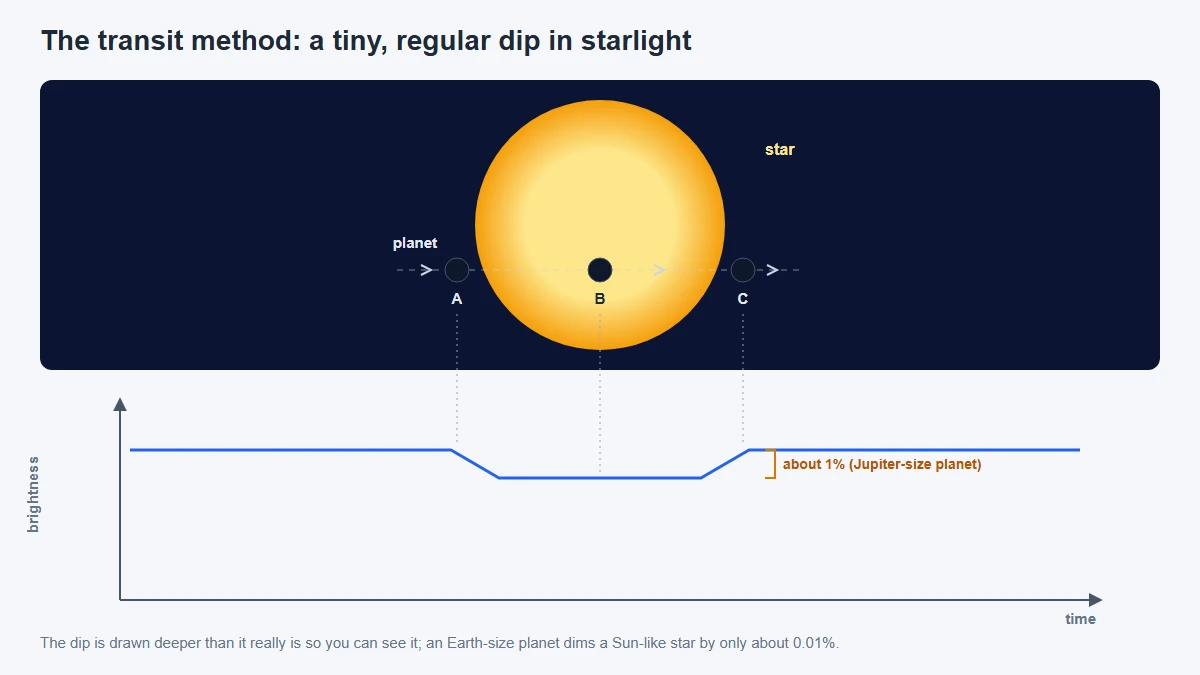
The dips are small.
A Jupiter-size planet crossing a Sun-like star dims it by about 1 percent, while an Earth-size planet dims it by only about 0.01 percent.
Space telescopes are ideal for this work because they can measure brightness with great precision and watch the same stars for long periods without interruptions from weather or daylight.
A series of transits tells astronomers several things:
- Size: The depth of the dip reveals the planet's size relative to its star.
- Orbit: The time between transits gives the length of the planet's year.
- Reliability: Several evenly spaced dips help rule out one-off glitches, and follow-up checks weed out impostors such as pairs of stars eclipsing each other.
The main limitation is geometry: only a small fraction of planetary systems are tilted so that their planets cross in front of their stars from our point of view.
The Wobble Method
A planet does not simply orbit its star.
The two actually orbit their shared center of mass, so as the planet circles, the star makes a small wobble of its own.
When the star moves slightly toward Earth, its light is compressed toward bluer wavelengths.
When it moves away, its light is stretched toward the red. This is the Doppler effect,
the same principle that makes a passing siren change pitch.
By splitting starlight into a detailed spectrum and tracking these tiny shifts,
astronomers can detect the wobble and work out the planet's orbit and minimum mass. The motions are astonishingly small.
Jupiter makes the Sun move at about 12 meters per second,
while Earth causes a wobble of only about 9 centimeters per second, slower than a crawling baby.
The best instruments can detect stellar motions of less than a meter per second.
This technique, called the radial velocity method, found many of the first known exoplanets.
Other Ways to Find a Planet
Direct Imaging
Sometimes astronomers can photograph a planet itself.
They block the star's light with a device called a coronagraph and use adaptive optics or space telescopes for sharp images.
This works best for large, young planets that are still hot and glowing in infrared and that orbit far from their stars.
The star HR 8799, for example, was shown to have four giant planets captured directly in images.
Gravitational Microlensing
Albert Einstein's theory of gravity predicts that mass bends light.
When a star passes almost exactly in front of a more distant star, its gravity acts like a lens and briefly magnifies the background star.
If the foreground star has a planet, the planet can add a short extra spike to the brightening.
These events happen once and never repeat, but they can reveal planets thousands of light-years away and even lonely planets drifting without a star.
Timing and Astrometry
Precise timing can reveal hidden planets too.
Besides pulsar timing, astronomers look for transits that arrive slightly early or late, a sign that another planet is tugging on the one they see.
Astrometry takes yet another approach, measuring the tiny sideways shift of a star's position in the sky as a planet pulls it back and forth.
Spacecraft that chart star positions with extreme precision, such as the European Gaia mission, have made this technique increasingly powerful.
Comparing the Methods
| Method | What it measures | Best at finding | Main limitation |
|---|---|---|---|
| Transit | Dips in a star's brightness | Planets on close, short orbits; gives size | Orbit must be lined up with our view |
| Radial velocity | Shifts in a star's spectrum | Massive planets close to their stars; gives minimum mass | Harder for small planets and very active stars |
| Direct imaging | Light from the planet itself | Young, hot giants far from their stars | Star's glare hides most planets |
| Microlensing | Brief magnification of a background star | Planets far from their stars, even free-floating ones | Each event happens only once |
From Detection to Understanding
The real power comes from combining methods. A transit gives a planet's size, and the wobble method gives its mass.
Put those together and you get its density, which tells scientists whether it is mostly rock, like Earth, or mostly gas, like Neptune.
Surveys have shown that the galaxy is full of planets unlike anything in our solar system,
including so-called super-Earths and mini-Neptunes, which fall between Earth and Neptune in size.
Scientists also pay close attention to the habitable zone,
the range of distances from a star where a planet could have the right temperature for liquid water on its surface.
In 2016, astronomers found a planet in that zone around Proxima Centauri, the closest star to the Sun.
In 2017, researchers announced that a small, cool star called TRAPPIST-1 hosts seven Earth-size planets, several of them in its habitable zone.
When a planet transits, some starlight filters through its atmosphere, and molecules there leave fingerprints in the light.
By studying those fingerprints,
telescopes such as the James Webb Space Telescope have detected gases like carbon dioxide and water vapor in the atmospheres of distant planets.
Frequently Asked Questions
Can you see an exoplanet with a backyard telescope?
You cannot see the planet itself,
but skilled amateur astronomers with good cameras can record the transits of some large planets that orbit close to their stars.
The star's brightness dips by around 1 percent for a few hours, which careful measurements can detect.
What is a hot Jupiter?
A hot Jupiter is a giant gas planet that orbits extremely close to its star, often completing a year in just a few days.
Such planets are relatively easy to detect, which is why several were among the first discoveries,
and their existence forced scientists to rethink how planetary systems form and change over time.
How far away are exoplanets?
The closest known exoplanets orbit Proxima Centauri, about 4.2 light-years away, so their light takes more than four years to reach us.
Many known exoplanets lie tens to hundreds of light-years away, and microlensing has revealed some thousands of light-years distant.
Worlds Beyond the Sun
Exoplanets are too faint and too close to their stars to photograph easily,
so astronomers read their presence in subtle clues: a star that dims on schedule,
a spectrum that shifts back and forth, a brief brightening as light bends through space.
Combined, those clues reveal planets' sizes, masses, orbits and even atmospheres.
The next time you look up at a starry sky,
remember that many of those points of light are likely circled by worlds of their own.
Sources and Further Reading
This article was reviewed by the LoudComet editorial team against the official sources below. Mission details and sky events change over time, so check the agencies' own pages for the latest information.
- How We Find and Characterize Exoplanets, NASA Science: How the transit, radial velocity (wobble), microlensing and direct imaging methods work, including direct images of HR 8799's four planets.
- Exoplanet detection methods, ESA Science & Technology: The wobble, astrometry (Gaia), transit timing and one-time microlensing methods, and 51 Pegasi b found by Mayor and Queloz.
- Will the real 'first exoplanet' please stand up?, NASA Science: The pulsar planets announced in 1992 from radio-pulse timing and the 1995 discovery of 51 Pegasi b around a Sun-like star.
- Exoplanet Watch, NASA Science: How amateur observers with small telescopes and cameras record the slight dimming of stars during planet transits.
- Exoplanets: In Depth, NASA Science: Proxima Centauri b as the closest known exoplanet, about 4 light-years away, and Kepler's finding that planets outnumber stars.