
Anúncios
A rocket launch looks like a single dramatic moment: a countdown, a flash of fire and a climb into the sky.
In reality it is the final act of weeks of preparation,
followed by a tightly scripted sequence of events that plays out in less than ten minutes on the way to orbit.
Anúncios
This step-by-step guide follows a typical launch from the assembly building to the moment a satellite drifts free in space.
Details vary from rocket to rocket, but the basic choreography is remarkably similar,
and knowing it will make the next launch you watch far more exciting.
Weeks Before: Assembly and Preparation
A rocket's stages usually arrive at the launch site separately. Depending on the design,
crews either stack them vertically inside a tall assembly building or join them horizontally and raise the finished rocket upright at the pad.
Engineers test electrical connections, valves, engines and flight software at each step.
The payload, whether a satellite, a space probe or a crew capsule, is prepared in a spotlessly clean facility.
Satellites are sealed inside a protective nose cone, called the payload fairing, that shields them from air pressure,
heat and noise during the climb through the atmosphere.
Mission planners also calculate the launch window, the period when the rocket can lift off and still reach its target.
For a trip to a space station, the window may last only an instant, because the rocket must launch as the station's orbit passes overhead.
A probe heading to Mars has a window measured in weeks, and those windows come around only about once every 26 months.
Launch Day: Weather, Range and Fueling
On launch day, weather officers watch conditions closely.
Rockets can be delayed by lightning nearby, thick clouds that could trigger lightning, strong winds at the ground,
powerful winds high in the atmosphere and temperatures outside the rocket's limits.
For crewed flights, forecasters also check the sea conditions in areas where a capsule might have to splash down in an emergency.
Meanwhile, the range team clears airspace and waters around the launch site and prepares radars and tracking stations.
Then comes fueling.
Many rockets use liquid oxygen, which must be kept colder than about minus 183 degrees Celsius (minus 297 degrees Fahrenheit),
and some use liquid hydrogen, which is colder still.
The billowing white clouds you see drifting around a fueled rocket are mostly moisture from the air condensing against the super-cold tanks,
mixed with oxygen vapor vented to keep pressure under control.
The Final Countdown
A countdown is counted in "T-minus" time, with T-0 being the moment of liftoff.
Most countdowns include planned pauses, called holds, which give teams time to catch up on tasks or fix small problems without rushing.
In the last minutes, the launch director polls each team one final time,
and every console answers "go" or "no-go." The rocket switches from ground power to its own batteries,
its tanks are pressurized, and computers take over an automatic sequence.
Any sensor reading outside its limits can stop the count in a split second.
Just before liftoff, a water system floods the pad with a torrent of water.
It absorbs some of the tremendous sound and vibration of the engines, which could otherwise damage the rocket and its payload.
Liquid-fueled engines ignite a few seconds before T-0, giving computers a moment to confirm they are running properly.
Only then do the clamps holding the rocket to the pad release.
Solid rocket boosters, which cannot be shut down once lit, ignite at the very last moment.
Liftoff and the First Minutes
A heavy rocket rises slowly at first, then accelerates as it burns off propellant and grows lighter.
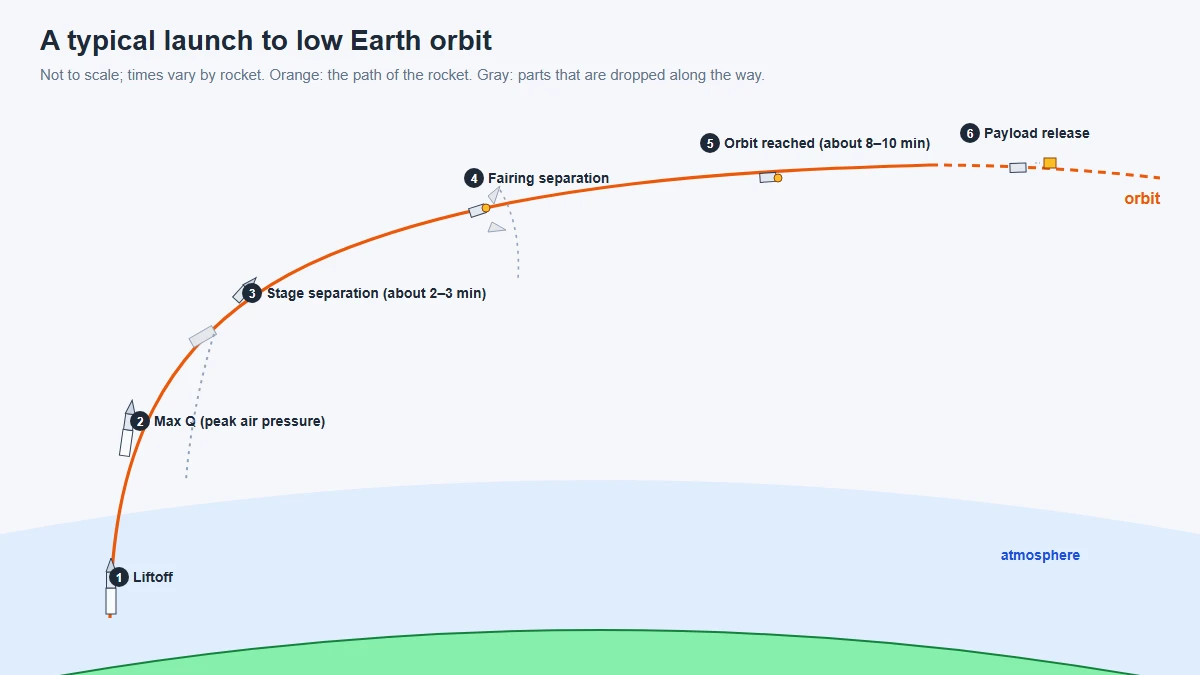
The timing below is typical of many orbital launches, although every rocket and mission differs:
- Liftoff and tower clear: Within seconds, the rocket clears the launch tower. On NASA crewed missions, that has traditionally been the moment control passed from the launch team in Florida to mission control in Houston.
- Pitch over: Seconds later, the rocket starts tilting toward its target direction, beginning the gradual arc that builds sideways speed for orbit.
- Going supersonic: Within about a minute, the rocket breaks the sound barrier.
- Max Q: Roughly a minute or so after liftoff, the rocket passes through maximum dynamic pressure, when the combination of speed and air density puts the greatest stress on its structure. Many rockets throttle their engines down briefly to get through it.
- Booster separation: Rockets with strap-on boosters usually drop them about two minutes into the flight, once they burn out.
Staging: Dropping Dead Weight
After around two to three minutes, the first stage has used up most of its propellant.
Its engines shut down in a moment called main engine cutoff, and the stage separates, pushed away by springs or small thrusters.
On reusable rockets, the booster then begins its own trip back to Earth.
Seconds later, the second stage engine ignites and continues the climb.
By now the rocket is high above most of the atmosphere, so the payload fairing splits open and falls away,
shedding weight that is no longer needed. This is often the first moment the satellite itself is exposed to space.
Reaching Orbit and Letting Go
The second stage keeps burning for several minutes, adding the speed needed to stay in orbit.
For low Earth orbit, that means about 28,000 kilometers per hour (17,500 miles per hour).
When the target speed is reached, usually around eight to ten minutes after liftoff, the engine shuts down and the vehicle is officially in orbit.
For higher destinations,
the upper stage may coast for a while and then fire again to stretch its orbit toward its final altitude or send a probe away from Earth entirely.
Finally, the payload separates, often with a gentle push from springs.
Engineers wait anxiously for the first signal from the spacecraft and confirmation that its solar panels have opened, which can take minutes or hours.
The spent upper stage is then often steered into a disposal orbit or back into the atmosphere so it does not become long-lived debris.
Safety Systems Along the Way
Crewed spacecraft carry launch abort systems, powerful rockets that can pull the capsule away from a failing launcher in an instant.
They have proved their worth: in 1983, a Soviet crew escaped unharmed when their escape system fired seconds before their rocket exploded on the pad.
Rockets also carry flight termination systems that can end a flight if the vehicle strays off course toward populated areas.
Range safety teams watch the trajectory throughout the climb, ready to act within seconds if needed.
From Countdown to Orbit
A rocket launch compresses an extraordinary amount of engineering into a few minutes: months of preparation, a carefully checked countdown,
the brute force of liftoff and a precise sequence of staging, steering and separation.
If you watch one in person, follow the viewing rules set by local authorities, expect delays,
since launches are often postponed at the last minute,
and remember that the roar arrives several seconds after you see the flame,
because sound travels far more slowly than light.
Sources and Further Reading
This article was reviewed by the LoudComet editorial team against the official sources below. Mission details and sky events change over time, so check the agencies' own pages for the latest information.
- Artemis I Launch Countdown 101, NASA: T-minus countdown with built-in holds, the launch director's go/no-go poll, the switch to internal power and engine start seconds before liftoff.
- Artemis II Weather Criteria, NASA: Launch weather rules for lightning, clouds that can trigger lightning, ground winds, upper-level winds and temperature limits.
- Launch Abort System, NASA: How a launch abort system fires within milliseconds to pull the crew capsule away from a failing rocket.
- Basics of Space Flight, Chapter 14: Launch, NASA Science: Launch windows, upper stages and the roughly 28,000 km/h speed a spacecraft needs to orbit Earth.
- Types of orbits, European Space Agency (ESA): Why a launcher must add sideways speed to reach orbit and how transfer orbits carry satellites up to their final orbits.